

The EU Family Member Residence Card (in Spanish, tarjeta de residencia de familiar de ciudadano de la Unión) is the document that lets a non-EU relative of an EU, EEA, or Swiss citizen live and work legally in Spain for up to five years. At Lexmovea we help English-speaking families obtain, renew, and defend this card, building a file that meets the standard from the first review so your residency in Spain is secure and predictable.
One thing to settle before anything else, because it decides your whole route: this card is for relatives of EU, EEA, or Swiss citizens who are not Spanish. If your family member is a Spanish national, the rules changed on 20 May 2025 and you no longer use this card — you apply for a separate residence authorization. We explain that distinction below, and we confirm your correct path before any document is collected.
What is the EU Family Member Residence Card in Spain?
The EU Family Member Residence Card is a temporary residence permit granted to non-EU family members of citizens of the European Union (EU), the European Economic Area (EEA), or Switzerland who are exercising their right of free movement and residing in Spain. It allows the holder to live and work in Spain — as an employee or self-employed — on the same footing as the EU citizen they accompany or join. The card is normally issued for an initial period of five years (or two years for unregistered durable partners).
It is governed by the EU free-movement framework: Directive 2004/38/EC, Spain’s Royal Decree 240/2007, and Order PRE/1490/2012. That legal base matters, because it is what gives this route its broader rights and its five-year initial validity compared with general-regime permits.
Important 2025 change: family of an EU citizen vs. family of a Spanish citizen
This is the single most common mistake we see, and much of the advice still online is now outdated. Until May 2025, non-EU relatives of Spanish nationals were processed by analogy under the same EU community regime. That is no longer the case. Under the new Immigration Regulation (Real Decreto 1155/2024), in force since 20 May 2025, the two situations follow different procedures, and you cannot choose between them — the nationality of your family member decides it:
- Family member of an EU, EEA, or Swiss citizen (not Spanish): this page applies to you. You apply for the EU Family Member Residence Card under the community regime (form EX-19), with the five-year card and free-movement rights described here.
- Family member of a Spanish national: since 20 May 2025 you no longer use the community card. You apply under a separate route for relatives of Spanish citizens (articles 93–99 of Real Decreto 1155/2024). We cover that process on our dedicated page: Temporary Residence for Family Members of Spanish Citizens.
If you are not sure which applies — for example, your relative holds dual Spanish and another EU nationality, or recently naturalized as Spanish — that is exactly the kind of point we confirm at the start, because choosing the wrong regime is one of the most common causes of avoidable refusals.
Who can apply for the EU Family Member Residence Card?
This route is for non-EU relatives of an EU, EEA, or Swiss citizen who is already registered in Spain’s Central Register of Foreign Nationals. The qualifying family members are:
- Spouses or registered partners of the EU citizen (where the marriage or partnership has not been annulled, dissolved, or legally terminated).
- Unregistered durable partners, where a stable relationship can be proven — typically at least one year of cohabitation, or having children in common.
- Children under 21, and children over 21 who are financially dependent, of the EU citizen or of their spouse/registered partner.
- Direct ascendants (parents and parents of the spouse/partner) who are dependent on the EU citizen.
- Other dependent relatives (such as siblings, grandparents, or grandchildren) where you can prove genuine dependency, prior cohabitation with the EU citizen in the country of origin, or serious health or disability grounds requiring personal care.
Do you qualify? The condition on the EU citizen’s side
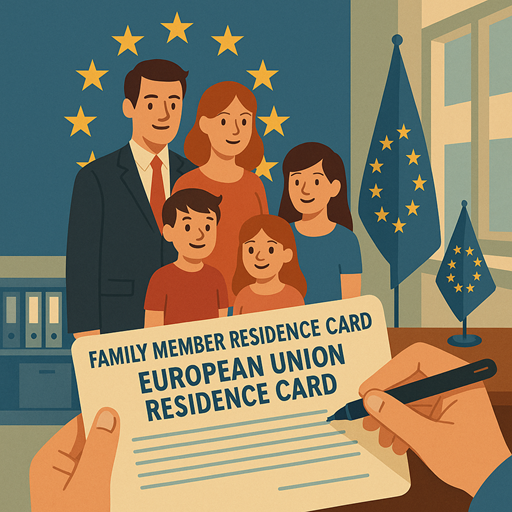
A key point that surprises many applicants: your eligibility depends not only on the family link, but on the EU citizen meeting the free-movement conditions. The non-EU relative’s right to reside is derived from the EU citizen’s own right to reside in Spain. In practice, the EU citizen must fall into one of these four situations, and the documents you prepare depend on which one applies.
If the EU citizen is employed
The EU citizen proves their work activity — for example a registered employment contract, a hiring notification through the official platform, or an employment certificate showing the company details — together with proof of being registered with Social Security. This is usually the most straightforward profile to document.
If the EU citizen is self-employed
Here the EU citizen evidences their economic activity — registration in the relevant tax/economic-activity census, business registration where applicable, and proof of Social Security registration as self-employed (or consent for the authorities to verify it).
If the EU citizen is not working (financially self-sufficient or retired)
If the EU citizen does not work in Spain, two things must be shown: comprehensive public or private health insurance with full coverage in Spain (pensioners can prove state-funded healthcare from the country paying the pension), and sufficient financial resources for the family unit so as not to become a burden on Spain’s social assistance system. Funds can be proven by various means — property, certified income, bank certificates, and similar. This is the profile where files most often fall down, so the financial evidence has to be consistent and well-structured.
If the EU citizen is a student
The EU citizen shows enrollment at a recognized public or private institution, health insurance with coverage in Spain, and a declaration of sufficient resources for the family unit during the period of residence. Note that if the EU citizen will only be in Spain for a limited period, the family card may be issued for that shorter timeframe rather than the full five years.
Documents needed for the EU Family Member Residence Card
The exact list depends on your relationship and the EU citizen’s profile, but most files are built from the same core. Getting these right — properly apostilled and sworn-translated where required — is the single biggest factor in avoiding delays.
From the EU citizen
- Passport or national ID, plus the Certificate of Registration as an EU citizen in Spain (Certificado de Registro de Ciudadano de la Unión, the green certificate or NIE).
- Evidence of their situation — employment, self-employment, sufficient means and health insurance, or student status — as set out above.
- Joint municipal registration (empadronamiento conjunto) of the EU citizen and the family member, where applicable.
From the non-EU family member
- A valid passport (if expired, a copy plus the renewal application).
- Proof of the family relationship, apostilled or legalized and sworn-translated where required: marriage certificate for spouses; registered-partnership certificate; birth certificates for children; evidence of a stable relationship for durable partners; and documentation of dependency for ascendants or adult dependent children.
- Three recent passport-size colour photographs on a white background.
- Form EX-19, completed and signed, and proof of payment of fee 790 Code 012 at the card-issuance stage.
One practical note that catches people out: foreign public documents generally need to be apostilled (or legalized) and officially translated into Spanish. Standard EU multilingual forms are usually exempt. We check this for every document so nothing is rejected on a technicality.
How to apply for the EU Family Member Residence Card
The application is submitted to the Immigration Office (Oficina de Extranjería) of your province of residence, in person or through a legal representative such as an immigration lawyer. There are two channels, and the legal deadline to apply is three months from your date of entry into Spain.
- Online (recommended): submit the EX-19 form and supporting documents through the Mercurio platform using a digital certificate. This is usually the most efficient channel.
- In person: book an appointment (cita previa) at the Immigration Office and attend with the required documentation.
In both cases the broad sequence is the same: an initial assessment of your case, document preparation, submission, a fingerprinting (biometrics) appointment after a favourable decision, and collection of the physical card. After filing you receive a receipt that lets you track your case and proves your legal stay while it is processed.
Cost
The procedure itself has no application fee. The only official charge is the card-issuance fee of around €12 (fee 790, code 012), paid when the card is issued. Beyond that, the costs that vary are third-party items — sworn translations, apostille or legalization — and, if you choose it, professional representation.
Timelines
The Immigration Office has a legal period of three months to resolve. If there is no decision within that time, the application is, in principle, deemed rejected by administrative silence — which is why filing a clean, complete file and tracking it actively matters. In practice, depending on the province and the workload of the office, the real timeframe can run longer, and we plan around that.
What the card gives you: rights and validity
The EU Family Member Residence Card is one of the most advantageous residence permits available, mainly because of its long initial validity and its full work rights.
- Right to live in Spain for an initial five years (or two years for unregistered durable partners; or a shorter period if the EU citizen’s own stay is shorter).
- Full right to work, as an employee or self-employed, with no additional permit and the same labour rights as Spanish nationals.
- A path to permanent residence: after five years of continuous residence meeting the conditions, you can apply for permanent EU family member residence.
- A NIE and a physical card proving your legal status under the EU family regime for identification, contracts, banking, and everyday procedures.
The card is also resilient in difficult moments: in cases of the EU citizen’s death, or divorce or termination of the partnership, non-EU family members can keep their residence right where the conditions set by the regulations are met (for example, a qualifying period of prior residence). If your circumstances change, that is a point worth getting advice on quickly, because deadlines apply.
Renewal and the physical TIE card
Once your card is approved, you complete the issuance of the physical card (the EU family member TIE). For that stage you generally submit the EX-17 form, proof of payment of fee 790 Code 012, the resolution granting your card, and three recent passport-size photographs, followed by fingerprinting.
The first card is valid for five years. The renewal of the EU family member card should be started as the expiry date approaches — broadly, from shortly before expiry and within the months that follow it. Starting early avoids gaps in your legal status. If your qualifying link changed (for example after a separation or divorce), renewal may require additional proof, or a modification to another permit may be the right move — we assess which applies to your case.
Our service
At Lexmovea we guide you through the whole process, from the first assessment of your case to approval, the physical card, and later renewal. Our help is structured around the points that actually decide these cases.
- Route confirmation first: we confirm whether you fall under the EU family regime (this card) or the route for relatives of Spanish nationals, before any document is collected.
- Personalized legal advice: we analyze your relationship type and the EU citizen’s profile, and define exactly what evidence your case needs — no over-collecting, nothing essential missing.
- Document preparation: we assemble and review the file, including apostille and sworn-translation planning, so it reads clearly to the reviewing office.
- Submission and follow-up: we file through the correct channel and track your case, responding to any request for further documents (requerimiento).
- Appeals and remedies: if the application is refused, we analyze the grounds and prepare a structured appeal within the deadlines.
Common mistakes we help you avoid
- Using the wrong regime: applying as family of an EU citizen when your relative is Spanish (post-May 2025), or vice versa. The nationality of your family member decides the route.
- Weak proof on the EU citizen’s side: forgetting that the EU citizen must evidence work, self-employment, sufficient means, or student status — not just the family link.
- Document defects: missing apostille, missing sworn translation, or expired certificates — the most frequent cause of avoidable delays.
- Missing the three-month window from entry, or letting a renewal lapse.
Frequently asked questions
Can a non-EU spouse get residence in Spain through an EU citizen?
Yes. The spouse or registered partner of an EU, EEA, or Swiss citizen residing in Spain can apply for the EU Family Member Residence Card, provided the marriage or partnership is valid and the EU citizen meets the free-movement conditions (work, self-employment, sufficient means and insurance, or study). If your spouse is a Spanish national, you apply instead under the route for family members of Spanish citizens.
Do children of EU citizens qualify for a residence card in Spain?
Yes. Children under 21 of the EU citizen or of their spouse/partner qualify, and so do children over 21 who are financially dependent. For minors not living in Spain with both parents, you provide documentation proving their status as a dependent family member.
How long does the EU Family Member Residence Card take?
The Immigration Office has a legal period of three months to decide. In practice, depending on the province, it can take longer. A complete, well-evidenced file generally moves faster than one with inconsistencies or missing standards.
How much does the card cost?
There is no application fee. The only official cost is the card-issuance fee of around €12 (fee 790, code 012). Other costs depend on your case — sworn translations, apostille or legalization, and professional fees if you use a lawyer.
Can I work with the EU Family Member Residence Card?
Yes. The card allows you to work in Spain as an employee or self-employed, with no additional permit and the same labour rights as Spanish nationals.
Can an unmarried partner apply?
Yes, an unregistered durable partner can apply if they prove a stable relationship — typically at least one year of cohabitation, or having children in common. Evidence such as joint municipal registration, joint accounts, and shared bills strengthens the application. For unregistered partners the card is often issued for two years rather than five.
How do I renew the card?
The first card is issued for five years, and you should start the renewal as expiry approaches to avoid any gap in status. If your qualifying family link has changed (for example after divorce), renewal conditions differ and a modification to another permit may be more appropriate — it is worth a quick case review.
Is this the same as permanent residence?
No. This is an initial temporary card. After five years of continuous residence meeting the conditions, you can apply for permanent EU family member residence, which is a separate and more stable status.
What if my application is refused?
Review the grounds for refusal and act within the deadlines: typically an administrative appeal within one month, and, if needed, a contentious-administrative appeal within two months. Legal advice helps you choose the right response and address the actual reason for the denial.
My family member is a Spanish citizen — does this card apply to me?
No. Since 20 May 2025, relatives of Spanish nationals apply under a separate route (articles 93–99 of Real Decreto 1155/2024), not the community card. See our page on Temporary Residence for Family Members of Spanish Citizens, and we will confirm the correct route for your exact situation.
Do you have any questions?
If you have any questions about the EU Family Member Residence Card or any other immigration procedure in Spain, contact Lexmovea. We confirm your correct route, prepare a file built to standard, and support you in English from start to finish — through approval, your EU family member NIE, the physical card, and renewals.