
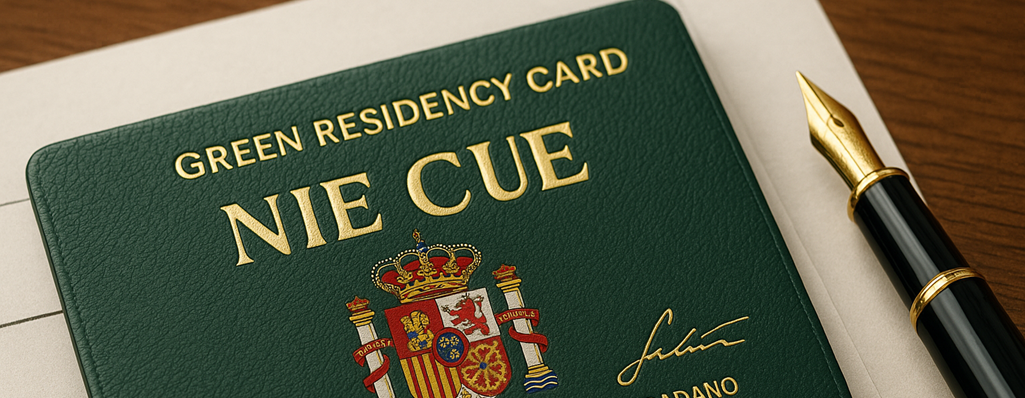
If you are an EU, EEA, or Swiss citizen planning to live in Spain for more than three months, the EU Citizen Registration Certificate — universally known as the Green NIE — is the document you need. Its official name is the Certificado de Registro de Ciudadano de la Unión (often abbreviated CUE), and it proves you are registered in the Central Register of Foreigners as an EU citizen residing in Spain. This page explains, in plain English, exactly what it is (and what it is not), the documents you need by profile, the fee, where to book the appointment, and the practical details that decide whether you walk out with your certificate the same day.
The legal basis is EU Directive 2004/38/EC on free movement, transposed into Spanish law by Royal Decree 240/2007 (article 7). That framework is why the administration asks for different proof depending on whether you work, study, or live on your own means.
Green NIE vs NIE vs TIE — the confusion, cleared up
The single biggest source of confusion. Three different things, often mixed up:
- NIE number — your Número de Identificación de Extranjero, a unique identifier for foreigners. It is just a number; on its own it does not prove residence.
- Green NIE / CUE — the EU registration certificate. A green paper document (A4 or card-sized, with no photo) that proves you are registered as an EU resident and that includes your NIE number. This is what this page is about.
- TIE — a physical plastic card for non-EU residents. EU citizens do not get a TIE for ordinary residence; they register and receive the green certificate instead.
In one line: the NIE is the number, the Green NIE is the proof of EU registration that contains that number, and the TIE is the card non-EU citizens carry. If your family member is a non-EU national, they do not register for a Green NIE — they apply for the EU family member card instead.
Who needs it, and by when

Any citizen of an EU member state, the EEA (Norway, Iceland, Liechtenstein), or Switzerland who intends to stay in Spain for more than three months must register and obtain this certificate. The legal deadline is to apply within three months of entering Spain. The certificate is what unblocks ordinary life here — registering for Social Security, signing an employment contract smoothly, opening certain bank products, enrolling for healthcare where applicable, and many official procedures that ask for proof of EU residence registration.
One useful point: your right to work in Spain comes from being an EU citizen, not from the certificate. You can start working as soon as you arrive and register within the three-month window — the certificate documents that right rather than granting it.
Requirements by profile (this is the part that matters)
Most failed appointments happen because people bring a generic document list that does not match their situation. Everyone needs the baseline set; then you add the proof for one of the qualifying bases. Start with the baseline:
- Valid passport or national ID (EU/EEA/Swiss), original plus copy.
- Form EX-18, completed and signed (the official application form).
- Proof of payment of the fee (model 790, code 012) — paid before the appointment.
- Copies of everything (a frequent reason appointments fail is missing photocopies — bring two full sets).
- Padrón (municipal registration) where the local office requests it as proof of address.
Then add your profile proof:
Employed
Proof of real employment in Spain: Social Security registration (your vida laboral or equivalent) and the employment contract or an employment communication. As an employee, the Social Security system covers your healthcare, so you do not need separate private insurance.
Self-employed (autónomo)
Proof you are properly set up: registration in the self-employed regime (RETA) and in the tax census (IAE/Hacienda), plus evidence your activity is real and ongoing. Incomplete registration proof is the usual stumbling block here.
Student
Enrolment or admission at a recognised public or private institution, full health insurance covering you in Spain, and a declaration of sufficient resources for your stay. A European Health Insurance Card covering the study period can serve for insurance; participation in an EU exchange programme is generally accepted as proof of means.
Self-sufficient (retired, pensioner, or economically inactive)
The two pillars are sufficient financial resources and health insurance. There is no fixed amount set in law, but the working threshold is 100% of the IPREM — about €600 per month (≈€7,200 per year) in 2026 for the applicant, with more for dependants. The insurance must give full cover equivalent to the Spanish public system, with no co-payments and no waiting periods — a basic travel policy will not be accepted. Bank statements should show stable balances; recent unexplained deposits raise doubts.
Family member of an EU citizen
If you are an EU/EEA/Swiss national joining a qualifying EU citizen, you prove the family relationship and that the EU citizen meets one of the bases above (work, means, or study). If the family member is a non-EU national, the route is different — the EU family member card, not this certificate.
Foreign documents generally need apostille or legalisation and a sworn translation where they are not in Spanish.
The fee, and what it costs in total
The government fee is paid with model 790, code 012, under the heading for the EU registration certificate. The amount is around €16 in 2026 (it is updated periodically, and a few sources still cite €12). You pay it at a collaborating bank or online before the appointment, and you must bring the stamped proof of payment — without it, the office will not accept your file. For most profiles there are no other official costs; extra costs only arise if you need translations, legalisation, or copies.
How to apply, step by step
- Confirm your profile and gather the baseline plus profile documents.
- Complete the EX-18 at home, cleanly, with no corrections.
- Pay the 790-012 fee and keep the stamped proof.
- Book the cita previa at the National Police / Immigration appointment system, choosing the procedure for “Certificado de registro de ciudadano de la Unión” in your province.
- Attend in person with originals and copies and your profile evidence. The officer checks your identity, the EX-18, the fee, and that your documents support your route.
Here is the part most pages bury: if your file is complete, the certificate is normally issued on the spot, in about 10–20 minutes. You leave with your green certificate and your NIE assigned the same day — one of the few immigration procedures in Spain where that happens. If something is missing, you receive a request to fix it (subsanación) with a short deadline, typically 10 days.
The appointment bottleneck
The certificate itself is simple; the genuine difficulty is the cita previa. In big cities appointments are scarce and disappear quickly, and slots often open at unpredictable times. The practical approach is to start early — do not wait until your 90-day window is nearly over — check availability across nearby offices, and make sure your documents are fully ready so that when a slot opens, you can take it without wasting it. Because availability depends entirely on the administration’s system and varies by province, no one can promise a date; what you control is being completely prepared.
Common reasons appointments fail
- Wrong or incomplete EX-18, or corrections on the form.
- Missing copies, or no stamped proof of the 790-012 fee.
- Insurance that doesn’t qualify — a basic travel policy instead of full cover with no co-payments or waiting periods.
- Unclear proof of funds — unstable balances or recent unexplained deposits.
- Profile mismatch — bringing employee documents for a self-sufficient case, or vice versa.
After you get it: changes, replacement, and permanent residence
The green certificate does not expire. What can change is your situation: the right it documents can lapse if you stop meeting the condition that justified it (for example, losing your job without sufficient own means) — but that loss is not automatic, and the administration must open a procedure with EU-law guarantees. If your address or details change, you don’t “renew” in the classic sense; you request an updated certificate, and if you move province you request a new one with the same fee. If it’s lost or damaged, you request a duplicate.
The bigger milestone comes at five years: after five years of continuous legal residence, you can apply for the permanent residence certificate, which gives you the right to live in Spain indefinitely without having to keep meeting the article 7 conditions. The time you hold the Green NIE counts toward that — and toward other long-term steps, including nationality where you qualify.
If your circumstances later change through divorce or separation from the EU citizen who anchored your residence, the rules on keeping your status are specific — see our page on the community card after divorce.
How we help
For most straightforward profiles, this is a procedure you can complete yourself once you know exactly what to bring. Where Lexmovea adds value is the cases that go wrong: confirming your profile route, getting the means-and-insurance evidence right for self-sufficient and student cases, preparing the EX-18 and the fee correctly, planning the appointment strategy so you don’t waste a scarce slot, and handling cross-border bank or family documents that need legalisation. If you’ve had a refusal or a subsanación, we help you fix the file and re-file. We work in English throughout.
If you’d like a document pre-check or full support with your Green NIE, contact Lexmovea and we’ll confirm your route and exactly what your appointment needs.
Frequently asked questions
What is the Green NIE in Spain?
It is the EU Citizen Registration Certificate (CUE) — a green paper document proving you are registered in the Central Register of Foreigners as an EU/EEA/Swiss citizen residing in Spain for more than three months. It includes your NIE number.
Is the Green NIE the same as the NIE number?
No. The NIE is the identification number; the Green NIE is the registration certificate that proves your EU residence and contains that number. Related, but not the same.
What documents do I need?
The baseline is EX-18, a valid passport or national ID (with copies), and proof of the 790-012 fee, plus padrón where required. Then add your profile proof: employment and Social Security if employed; RETA and tax registration if self-employed; enrolment, insurance and means if a student; or means (around 100% of the IPREM) plus full health insurance if self-sufficient.
How much does it cost?
The fee (model 790, code 012) is around €16 in 2026, paid before the appointment. For most profiles there are no other official costs, beyond possible translations or legalisation of foreign documents.
How much money do I need to show if I’m not working?
There is no fixed legal amount, but the working threshold is 100% of the IPREM — about €600 per month (≈€7,200 per year) in 2026 for the applicant, with more for dependants — plus full health insurance with no co-payments or waiting periods.
How long does it take to get it?
Once you have the appointment and the correct documents, the certificate is usually issued on the spot, in about 10–20 minutes. The real wait is finding a cita previa, which varies by province and can take time in busy cities.
Can I do it online?
Not entirely. You can prepare the EX-18, pay the fee, and book the appointment online, but the process requires attending in person at the competent office to be issued the certificate.
Does it expire, and do I need to renew it?
It has no expiry date. You request an updated or replacement certificate only if your details change, you move province, or the document is lost or damaged. After five years of continuous legal residence you can apply for the permanent residence certificate.
What if I lose it?
Request a duplicate through the competent authority as soon as possible. Acting quickly avoids complications with banks, employers, and administrative procedures that rely on it.