Searching in English for arraigo familiar or family arraigo Spain? This is a Spain-specific residence route based on close family ties, commonly used by non-EU nationals who have a direct link to a Spanish citizen. On this page you’ll find clear eligibility scenarios, a complete documents checklist, a step-by-step filing process (including where to submit and what happens next), realistic timelines, work rights, and what to do if you receive a request for more documents or a denial.
Family roots (“arraigo familiar”) is a temporary residence authorization granted to foreigners who have qualifying family ties with Spanish citizens, such as being the parent of a Spanish minor or the child of Spanish-born parents. It is regulated under Article 124.3 of Royal Decree 557/2011 and generally allows the holder to reside and work in Spain under the conditions of the authorization, either as an employee or self-employed (depending on the scenario and the permit granted).
Quick Answer (for Featured Snippets / AI Overview)
What is “arraigo familiar”?
Arraigo familiar (family arraigo) is an exceptional residence authorization in Spain for certain non-EU nationals who can prove close family ties to a Spanish citizen (and in some cases specific caregiver situations). It can lead to a residence authorization that may include work rights, and it is designed to regularize status and provide stability based on family connection.
Key requirements (at a glance)
- Proof of relationship: Civil registry documents proving the family link and Spanish nationality (birth certificates, marriage/registered partnership certificates, etc.).
- Criminal record compliance: No disqualifying criminal convictions in Spain or relevant prior countries (where required).
- Administrative eligibility: No entry ban/prohibition, no active non-return commitment, and ability to submit the correct form and fee.
What you get (duration, work rights, next steps)
If approved, you obtain a residence authorization under exceptional circumstances. Depending on your scenario, it can be granted for a longer period (commonly referenced as up to five years in certain cases) or for a shorter period (commonly one year in other specific cases). After approval, you will typically need to complete the TIE process (fingerprints/appointment) to obtain your physical Foreigner Identity Card.
What is Family Arraigo Residency?
The family roots residency is one of the exceptional circumstances that allow foreigners to obtain temporary residence authorization in Spain. It applies to those who are not subject to the EU citizens’ regime and can demonstrate first-degree family ties with Spanish citizens (and other specific qualifying family/care scenarios). The authorization may be granted with work rights and with a validity that depends on the qualifying category. For many applicants, this route is a faster and more direct alternative to other permits because it is grounded in family connection rather than employment sponsorship or long residence periods.
Do You Qualify? (Eligibility by Scenario)
Who qualifies for family arraigo (arraigo familiar) in Spain? Eligibility depends on your exact relationship to a Spanish citizen and your personal circumstances. Below are the most common scenarios. If you’re unsure which one fits—or whether another route (EU family card / family reunification) is better—an eligibility assessment is the safest way to avoid filing the wrong application.
Who Can Apply for Family Roots Residency?
There are several circumstances under which you may obtain an arraigo familiar authorization. If you meet one of the following categories, you may be eligible to start the application process:
- Parents of Spanish Minor Children:
If you have a minor child who is a Spanish citizen, you may be eligible to apply whether or not you live with the child. If you do not live with the child, you must demonstrate that you fulfill your parental obligations (for example: child support and/or compliance with a visitation regime where applicable). These cases are highly evidence-driven—strong proof avoids delays and requests for additional documents. - Spouse or Registered Domestic Partner of a Spanish Citizen:
If you are married to or in a registered domestic partnership with a Spanish citizen, you may be able to apply under family-ties residence. The key is proving the relationship and (in many offices) demonstrating the stability of the link through consistent civil registry documentation. “Registered partner” refers to an officially registered partnership; unregistered stable relationships usually fall under different routes. - Ascendants or Descendants of Spanish Citizens:
This can include parents (often evaluated by age and dependency criteria), and children (commonly under 21, or over 21 with proof of financial dependency). These files often hinge on how dependency is proven—so evidence strategy matters.
Parent/caregiver scenarios (dependency/care evidence)
Some family arraigo cases depend on proving care or dependency (for example, caring for a Spanish citizen with a disability or needing support to exercise legal capacity). These are “proof-standard” cases: the administration will look for evidence that you live with and care for the person, and that the support need is documented. Weak or inconsistent proof is one of the most common reasons for delays or refusal.
Spouse/partner of a Spanish citizen — does arraigo familiar apply or is another route better?
Some applicants assume any partner route is the same. It is not. The best route depends on whether the Spanish citizen is the sponsor and whether your relationship is married/registered, whether you already hold EU family status, and whether you are applying from inside Spain or outside. A correct route decision at the start prevents rejections and lost months.
Family member of an EU citizen in Spain (when the EU family card may apply)
If your qualifying family member is an EU citizen (not Spanish), you may fall under the EU family regime rather than arraigo familiar. In these cases, the EU Family Card route may be more appropriate and often has different proof requirements (cohabitation, EU citizen residence, etc.). Choosing the right legal basis is a core part of a successful strategy.
Why Choose Lexmovea for Your Family Arraigo Application?
At Lexmovea, we provide a structured, service-led approach to arraigo familiar. Our focus is not only “what the law says,” but how to build a strong file that withstands Extranjería review, especially in dependency/care and custody scenarios where proof standards are decisive.
- Experience and Expertise:
We handle family-ties residence applications with an evidence-first approach and stay current with procedural criteria and common refusal patterns. - Personalized Case Analysis:
We map your scenario to the correct legal route and define the proof strategy to maximize approval chances. - Comprehensive Process Management:
We prepare your documentation pack, complete forms/fees correctly, submit the application, and monitor progress. - Continuous Support:
We assist with questions, requests for additional documents (requerimientos), and follow-up steps. - Legal Representation:
If a denial occurs, we can guide you through appeal strategy within legal deadlines. - Peace of Mind and Confidence:
Clear expectations, clear checklists, and a plan you can follow from filing to TIE.
Requirements & Documents (Checklists)

What documents are needed for arraigo familiar? Exact requirements can vary by scenario and office, but successful applications follow a consistent structure: identity + criminal records (where required) + proof of family relationship and Spanish nationality + scenario-specific proof (custody, dependency/care, registered partnership, etc.) + fee payment + correctly completed form.
General Requirements for Family Roots Residency
- Nationality: You must not be a citizen of the European Union, European Economic Area, or Switzerland, nor a family member of citizens of these countries with the right to community residence.
- Criminal Record: You must not have a criminal record in Spain or in your previous countries of residence for offenses covered under Spanish law.
- Legal Entry and Stay: You must not be prohibited from entering Spain or listed as inadmissible in countries with which Spain has migration agreements.
- Commitment to Non-Return: You must not be subject to any voluntary commitment to not return to Spain.
Specific Requirements for Family Roots Residency
Below are the specific requirements for family roots residency based on the applicant’s situation. You must meet at least one of the following conditions and support it with the right evidence:
- Parent, Legal Guardian, or Caregiver of a Spanish Minor:
You must have the minor under your care (cohabitation can simplify proof), or if you do not live with the child, you must prove you meet your parental obligations (support/visitation). These cases often require a carefully organized evidence pack. - Providing Support to a Person with Disabilities:
If you provide support to a Spanish citizen with a disability or who needs assistance to exercise legal capacity, and you live with and care for them, you may qualify. Proof standards are high: medical/disability documentation and evidence of care/cohabitation are key. - Spouse or Registered Domestic Partner of a Spanish Citizen:
You must prove the marriage/registered partnership and, where relevant, cohabitation/stability evidence depending on local criteria and the scenario. - Ascendant or Descendant of a Spanish Citizen:
For some categories, dependency proof is essential (especially for adult descendants or ascendants under certain age thresholds). Evidence should show real economic dependency, not only a family relationship. - Child of Parents Who Were Originally Spanish:
Specific requirements apply and must be analyzed case-by-case. Evidence must prove the parent’s original Spanish nationality and your link to that parent.
Each case is unique and may require additional documents if Extranjería issues a request for clarification. A structured review before filing helps prevent delays and refusals caused by missing proof or inconsistent foreign documents.
Apostille/legalization + sworn translations (how to prepare foreign documents)
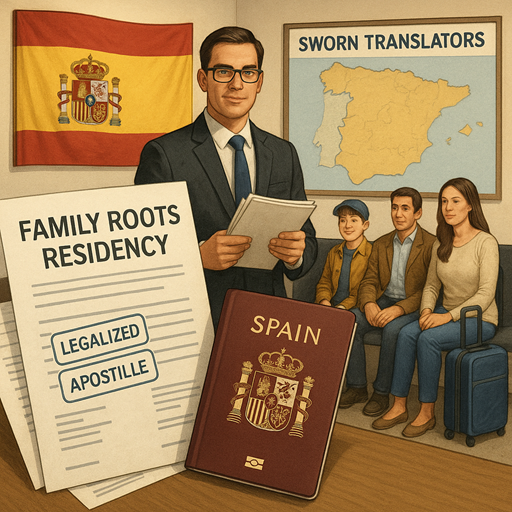
Important: Documents issued outside Spain usually must be legalized or apostilled and, when required, translated by a sworn translator. Validity windows also matter: many certificates have time limits for acceptance. Preparing foreign documents correctly is one of the most common “hidden” failure points, especially in custody/dependency cases.
Limitation of Family Rooting in 2025: Only One Caregiver Relative for Disability
Instruction SEM 1/2025 specifies that the family rooting provided for the support/caregiver disability scenario is reserved exclusively for the relative who provides that support. In practice, this means this modality can only be requested by one qualifying relative who meets the legally established requirements.
This rooting can only be requested by a single relative who meets the legally established requirements.
Types of Family Roots Residency Based on the Qualifying Family Member
Family Roots Residency for Parents of Spanish Minors
The first pathway to obtain family roots residency is through the relationship with a minor child who is a Spanish citizen. The practical difference between strong and weak cases is proof: demonstrating the child’s Spanish nationality and your parental responsibilities with clear, consistent documents.
Having a Spanish Minor Child:
If you are the parent of a Spanish minor, you can apply regardless of whether you live with the child. Cohabitation is not always a strict requirement, but proof requirements differ depending on your living arrangement. Importantly, the focus is on the family bond and parental responsibility evidence rather than a generic “financial means” test in many cases.
- Cohabitation: If you live with your child, the process is usually simpler because the family bond is easier to evidence through joint registration records and day-to-day documentation.
- Non-cohabitation: If you do not live with your child, you must prove that you fulfill parental obligations (support/visitation compliance where applicable). Clear, organized proof prevents subsanación requests.
In these cases, the authorization granted may be for a longer validity period and typically includes work rights, allowing you to live and work legally in Spain during that period.
New Development: The regulations also contemplate caregiver/support scenarios for Spanish citizens with disabilities or requiring support to exercise legal capacity, where the caregiver lives with and cares for the person. These cases require strong evidence and careful preparation.
Family Roots Residency for Spouses of Spanish Citizens
With recent regulatory updates, residence through family ties can apply to spouses and registered partners of Spanish citizens. This may serve as an alternative route to regularize status for certain couples. However, “registered partner” refers to partnerships formalized through an official registry; unregistered stable partnerships often require a different legal route. The best option depends on your exact relationship status and whether EU-regime rules apply.
Which is Better: Family Roots Residency or the EU Family Card?
Many applicants confuse these routes. The right choice depends on whether your sponsor is Spanish or another EU citizen, and on your relationship status and documentation. Here’s a practical routing summary:
- The EU Family Card is generally the appropriate route for relatives of EU citizens (non-Spanish EU nationals). It relies on proving the family relationship and the EU citizen’s residence and, commonly, cohabitation in Spain.
- Family Arraigo (Arraigo Familiar) is generally a route grounded in family ties to Spanish citizens and specific caregiver scenarios. It is designed as an exceptional circumstances authorization and is filed with Extranjería under the corresponding procedure.
Benefits of Family Roots Residency for Relatives
When granted, family arraigo typically provides residence stability and includes work authorization (employee or self-employed) according to the terms of the authorization. It can be a powerful solution for those who need to regularize quickly based on family ties, without relying on an employer sponsorship route.
Family Roots Residency for Ascendants of Spanish Citizens or Their Registered Partners
Parents of Spanish citizens (or of their registered partners, depending on the scenario) can apply for this residence authorization where the legal conditions are met. Dependency evidence is often decisive, especially for ascendants under certain age thresholds.
- For parents under 65 years old, they often must demonstrate financial dependence on the Spanish citizen or their partner.
- For parents over 65 years old, dependency may be evaluated based on the criteria applied by the competent office and the factual circumstances.
Family Roots Residency for Children of Spanish Citizens
Children under 21 of a Spanish citizen (or their registered partner, depending on the scenario) can also qualify in certain cases. For children over 21, proof of financial dependence is typically required to meet eligibility criteria.
Family Roots Residency for Children of Spanish-Born Parents
This pathway is available to individuals who are the children of parents who were originally Spanish citizens. It requires precise civil registry evidence proving the parent’s original Spanish nationality and the applicant’s relationship link.
How to Apply (Step-by-Step)
Required Documentation for Family Roots Residency Application
To initiate the family roots residency application, you must prepare the correct form, pay the fee, and compile a scenario-specific evidence pack. Below is a step-by-step checklist structured to reduce delays and maximize approval chances.
- Application Form: Official form (EX-10), duly completed and signed by the applicant in duplicate.
- Valid Passport: A complete copy of the passport, travel document, or registration card, with a minimum validity of four months.
- Criminal Record Certificate: Issued by the authorities of the country or countries where you resided during the five years prior to entering Spain.
- Proof of Family Relationship and Nationality:
-
- If you are the parent of a Spanish minor:
-
- Birth certificate of the Spanish minor proving the family relationship and nationality.
- Documentation showing fulfillment of parental obligations if not living with the child.If you are a relative of a Spanish citizen:
-
- Documentation proving the family relationship (marriage certificate, registered partnership certificate, etc.).
- Proof that the Spanish relative resides legally in Spain (where applicable to the scenario).
-
-
- If you are the parent of a Spanish minor:
-
- If you are an ascendant or dependent descendant:
-
- Documentation proving economic dependence (consistent, traceable evidence).
-
- If you are an ascendant or dependent descendant:
-
- If you are the child of Spanish-born parents:
-
- Birth certificate of the applicant.
- Birth certificate of the parent proving their original Spanish nationality.
-
- If you are the child of Spanish-born parents:
-
- Proof of Payment: Receipt of the corresponding fee (Code 052 – Section 2.5 Temporary residence authorization under exceptional circumstances).
Important: All documents issued outside Spain must be legalized or apostilled and, if necessary, translated by a sworn translator. It is essential to verify specific requirements based on your country of origin and language.a por arraigo familiar en España
Application and Resolution of Residence by Family Roots in Spain

Where to Submit the Family Roots Residency Application
Where do I submit the arraigo familiar application? Applications must be submitted at the Immigration Office (Extranjería) corresponding to your place of residence in Spain. You can submit either in person (appointment required) or online through the Mercurio platform using a digital certificate. The best choice depends on your timing, document readiness, and whether you want faster submission without travel.
How to Submit the Family Roots Residency Application
How do I apply for arraigo familiar in Spain? There are two main submission routes. The key in both is filing a complete, coherent evidence pack to avoid a request for additional documents:
- In person: Schedule an appointment at the Immigration Office and attend with all required documentation, originals + copies, and proof of fee payment.
- Online: Use a digital certificate to submit via Mercurio. This can be faster and reduces appointment bottlenecks, but your documents must be correctly prepared and clearly scanned.
Tracking the Application
Once submitted, you receive a receipt. This is critical: it is your proof of filing and allows you to track the status of your application. Keep it safe, as it may also be needed for follow-up steps and to prove that your file is in process.
Processing Time
How long does arraigo familiar take to be approved? The legal deadline is three months from submission for the Immigration Office to process and respond. If no response is received within that period, it may be considered denied by administrative silence. In practice, some offices take longer due to workload. The best way to reduce delays is to file a clean, complete evidence pack and respond quickly to any requests for clarification.
Approval of Family Roots Residency
If approved, you will receive a residence authorization (often with work rights). The next step is to apply for your TIE (fingerprints appointment) so you have your physical identification card. This “after approval” phase is frequently under-explained by competitors, yet it’s essential for day-to-day life and employment onboarding.
Denial of Family Roots Residency
If your application is denied, you can typically file an administrative appeal within one month from notification, or pursue judicial recourse within two months. Denials often relate to relationship proof quality, dependency/custody weaknesses, or foreign document preparation issues. A denial should be assessed quickly because appeal deadlines are strict.
Important: Having the support of immigration experts, such as Lexmovea, helps ensure your application meets requirements and that any negative decision is handled strategically within deadlines.
After Approval
TIE appointment (fingerprints), documents needed, and timing
After approval, you generally must book a fingerprints appointment and apply for the TIE. Bring the resolution approval, your passport, photos (if requested), proof of fee payment for the card issuance (where applicable), and any documents required by your local police station. Appointment availability can be a bottleneck, so planning early is advisable.
Does arraigo familiar allow me to work in Spain?
Does arraigo familiar allow me to work? In many cases, yes—family arraigo is granted with work authorization, allowing work as an employee or self-employed according to the authorization. The practical point is timing: you generally rely on the authorization after approval and the post-approval steps (including TIE) to operate smoothly with employers and social security processes.
Travel considerations (pending vs approved)
Travel rules can be risky if your status is pending or if you do not yet have your TIE. If you need to travel while an application is in process, you should evaluate the risk carefully and consider whether additional documentation is needed to return to Spain. After approval, travel is typically more straightforward once you have your TIE and your status is fully documented.
Renewal of Family Roots Residency
Family Ties Residency Renewal: Renewal strategy depends on the type of arraigo familiar granted. Some scenarios lead toward long-term residence planning, while others require a change to a different permit at renewal. Proper planning avoids gaps and protects your long-term stability in Spain.
Renewal for Parents of Minors or Relatives of Spanish Citizens
If you obtained family roots residency as the parent of a Spanish minor or as a direct relative of a Spanish citizen (spouse, registered partner, parent, or child), the authorization may be valid for a longer period. Before its expiration, planning for long-term residence (where eligible) can be the most stable path because it allows you to live and work in Spain indefinitely.
Renewal for Children of Spanish-Born Parents
If you obtained family roots residency as the child of a parent who was originally Spanish, your card may be valid for one year. Upon renewal, you may need to choose a different residence permit, such as:
- Employment-based residence and work permit
- Self-employment-based residence and work permit
- Non-lucrative residence permit
Your choice will depend on your personal circumstances and future plans in Spain.
Details on Renewing Family Roots Residency
For specific requirements and procedures for renewal, consult our detailed renewal resource. Having a plan before the end of validity reduces stress, avoids missed deadlines, and helps you move into a more stable long-term status where possible.
Applicable Regulations for Family Roots Residency in Spain
The application and approval of family roots residency are based on regulations defining requirements, procedures, and applicant rights. These references are commonly cited in arraigo familiar applications and help explain the legal basis of the route.
- Instruction DGI/SGRJ/10/2008: Provides guidelines for specific family roots cases, such as children of parents who were originally Spanish.
- Organic Law 4/2000 (Immigration Law): Establishes basic principles and rights of foreign nationals in Spain, including exceptional circumstances residence routes.
- Royal Decree 557/2011 (Immigration Regulations): Develops the Immigration Law and specifies requirements, procedures, and documentation for exceptional circumstances residence, including family roots (Articles 123 to 130).
Questions and Answers About Family Roots Residency

- Where is the family arraigo (arraigo familiar) application submitted? The application is submitted at the Immigration Office (Extranjería) corresponding to your residence in Spain, either in person (appointment required) or online via Mercurio with a digital certificate.
- How long does the family roots residency process take? The legal processing time is three months, although it may vary depending on office workload. Filing a complete pack and responding quickly to any requests reduces delays.
- Can I work with family roots residency? Yes, family arraigo generally grants work authorization, allowing you to work either as an employee or self-employed according to the authorization.
- How long does family roots residency last? The duration depends on the qualifying family connection and scenario. Some categories are granted for longer periods (commonly referenced as five years), while others are granted for shorter periods (commonly one year). Always confirm your specific resolution.
- Can family roots residency be renewed? Yes, but renewal strategy depends on the scenario. Some cases lead toward long-term residence planning, while others require switching to a different permit at renewal.
- What happens if my family roots residency application is denied? You can generally file an appeal within one month or pursue judicial recourse within two months. Denials should be reviewed quickly because deadlines are strict and evidence strategy matters.
- Do I need a lawyer to apply for family roots residency? It is not always mandatory, but it is highly recommended for evidence-heavy cases (custody, dependency, foreign documents) and to reduce refusal risk through correct route selection and document preparation.
- Can I travel outside of Spain with family roots residency? Travel is possible, but risks depend on whether your status is pending or approved and whether you already have your TIE. Long absences may affect future renewals or long-term planning.
- Can I apply for Spanish citizenship with family roots residency? Legal residence can count toward nationality by residence, but eligibility depends on your total lawful residence time and other conditions. Always evaluate your personal pathway before relying on timelines.
- What happens if my family situation changes after obtaining family roots residency? Significant changes (for example: divorce, death of the qualifying relative, custody changes) can affect your status. You should inform Extranjería and evaluate whether you must modify to a different permit route to stay compliant.
- Can I change my type of residence after obtaining family roots residency? Yes, you can apply for a different permit if you meet its requirements. Many applicants plan a transition to long-term residence or another stable route depending on their scenario.
- What are the advantages of family roots residency compared to other residence types? It is often more direct for those with qualifying family ties, can include work rights, and can be less dependent on employer sponsorship compared to purely work-based permits.
- What is the most common example of family roots residency? A frequent scenario is a non-EU parent applying for residence based on being the parent of a Spanish minor child, with clear proof of the child’s nationality and parental responsibilities.
- What is family roots residency by simple presumption? This concept relates to nationality mechanisms for certain children born in Spain to foreign parents to prevent statelessness. It is not the same as an arraigo familiar application, but it can intersect with family documentation in some cases.
- Can family roots residency be requested for the mother or father of a child with Spanish nationality? Yes, in many cases, a parent of a Spanish minor child can apply, whether the applicant is the mother or father, provided the relationship and obligations are correctly evidenced.
- Can family roots residency be requested for a father or mother if the child is an adult with Spanish nationality? Generally, family arraigo is focused on specific qualifying scenarios. Adult-child cases are usually not eligible unless a specific exception applies, and alternative routes may be required.
- What are the main requirements for family roots residency through marriage? Typically: valid marriage certificate, proof of Spanish nationality, and evidence that supports the stability/validity of the relationship as required by the competent office. Foreign marriage documents often need apostille/legalization and sworn translation.
- What is community family roots residency? This term often reflects confusion. Family of EU citizens usually falls under the EU family regime (EU Family Card), which is a different route from arraigo familiar.
- Can family roots residency be requested for caregivers of Spanish citizens with disabilities? Yes, caregiver/support scenarios exist, but proof standards are high and the modality may be limited to a single qualifying relative. You must prove cohabitation, caregiving, and the documented need for support.
- What are the requirements for the five-year family roots residency card? Requirements depend on the scenario. Focus on proving the qualifying family link, meeting criminal record/public order requirements, and submitting correct documentation (including apostille/translation where needed). Avoid relying on generic “years in Spain” statements; arraigo familiar is not primarily a time-in-Spain route like other arraigo types.