
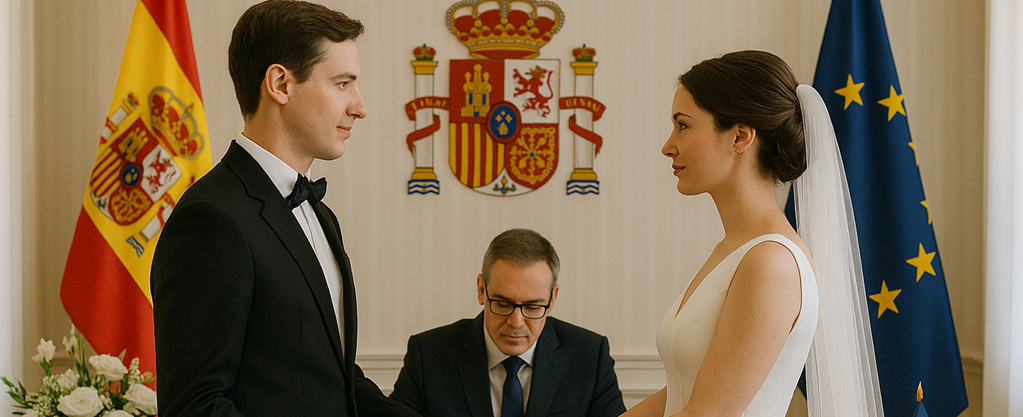
The processing of the marriage file before a notary is one of the most practical routes for international couples who want a civil marriage before a notary in Spain with more operational clarity, flexible scheduling, and a streamlined workflow compared to traditional channels. In most cases, it is viable as long as at least one of the partners has a residence connection in Spain (for example, through registration in a municipality within an Autonomous Community—often what clients mean when searching for civil marriage in Madrid with a notary). This procedure is regulated by Spanish law and exists to verify two essential points: (1) the legal capacity of both future spouses, and (2) the absence of legal impediments to marriage.
Our services is designed for English-speaking foreign nationals (and mixed-nationality couples) who want to understand feasibility, requirements, timelines, costs, and the real “next steps” after signing. It also answers the practical conversion blockers competitors often skip: apostille vs consular legalization, sworn translations, interpreter needs at the notary, validity windows for foreign certificates, witness rules, and how the marriage is registered after the notary ceremony.
Marrying a Foreigner Before a Notary
Uniting lives across borders is common in Spain—and so is the need for a marriage route that is clear, lawful, and manageable for couples with foreign documentation. Marriage before a notary in Spain (often searched as notary marriage Spain or marriage before a notary Spain) allows international and mixed couples to formalize their union through a civil ceremony where the notary acts as a legal guarantor. The notary verifies capacity, confirms there are no legal impediments, and formalizes the civil marriage with legal certainty.
This route can work for Spanish + foreign couples and also for two foreigners. Many couples choose it because they want predictable steps, document pre-checks, and a process that can be organized around real life (work schedules, travel, and international paperwork). The key to success is preparing foreign documents correctly (format, legalization/apostille, sworn translations, and validity periods) and building a complete marriage file that the notary can process without delays.
Who can use this route (eligibility for foreign nationals)
Eligibility depends on legal capacity to marry and practical requirements for the marriage file. The most common scenarios we handle include:
- Foreigner + Spanish citizen: typically straightforward if documents are properly prepared and evidence of identity/civil status is clear.
- Two foreigners: possible even if neither spouse is Spanish, provided the file can be processed with the required residence/municipal connection and documentation is complete.
- Residents vs non-residents: residency status affects practicality (especially for obtaining certificates, witness logistics, and appointments), not the civil right to marry itself.
- Tourists / short stays: possible in some situations, but only if document readiness and scheduling are realistic; most delays come from foreign certificate validity and legalization/translation timing.
- Divorced or widowed applicants: absolutely possible, but the file must include correctly legalized/translated evidence of divorce decree or spouse death certificate, as applicable.
What “Marriage Before a Notary” Means in Spain
A marriage before a notary in Spain is a civil marriage celebrated at a notary’s office (or another legally appropriate venue if arranged), where the notary is the competent authority for the act. It involves preparing the marriage file (expediente), verifying legal requirements and documentation, and holding the ceremony with the spouses and witnesses. After signing, the marriage must be registered so you can obtain official certificates used for immigration, surname changes, banking, and recognition abroad.
Is it a civil marriage?
Yes. A notary marriage is a civil marriage under Spanish law. The ceremony is not religious, and its legal effect is the same as a civil marriage celebrated at a Town Hall or via Civil Registry channels—what changes is the operational path: scheduling, file handling, and practical workflow.
Notary vs Civil Registry / Town Hall — key differences for foreigners
For foreign nationals, the key difference is not “validity” (both are valid), but operational management: notary workflows can be more structured around document pre-review, appointment flexibility, and process predictability. Civil Registry and Town Hall routes can involve longer queues, less predictable timelines, and higher friction for foreign documents. A notary route can reduce uncertainty, but it still requires correct foreign documentation and a complete marriage file.
Celebration of Marriage Before a Notary in Spain
A notary marriage Spain ceremony is carried out at the notary’s office, where the notary formalizes the union after verifying the marriage file. The process typically includes: submitting the required documentation, verifying legal capacity and lack of impediments, confirming identity, and celebrating the civil act in the presence of the spouses and witnesses. After the ceremony, the notary issues the corresponding documentation for the act and initiates the steps that lead to registration so you can later obtain the official Spanish marriage certificate.
Requirements for Getting Married in Spain
For couples planning a civil marriage before notary Spain, the requirements focus on capacity, civil status, and absence of impediments. The notary route can reduce administrative friction, but the legal conditions are the same. The core requirements are:
- Be of legal age: Both parties must be at least 18 years old.
- Not married to another person: Neither party can be legally married to someone else at the time of signing.
- No prohibited kinship: The couple cannot be related in a direct line or collateral line up to the second degree.
- No legal impediments: There must be no legal barriers preventing the marriage, including issues affecting legal capacity where applicable.
Requirements & documents (foreigner-first checklist)
Most delays happen because foreign documents are not prepared in the format the notary needs. A practical checklist typically includes identification, birth certificates, proof of civil status, and evidence of residence/municipal link. Foreign documents often require apostille or consular legalization and sworn translation into Spanish. The exact list and format can vary by personal circumstances (nationality, previous marriage, country document issuance rules), so document pre-review is essential.
Certificate of no impediment / single status: what if your country doesn’t issue it?
Many countries issue a “single status” certificate or “certificate of no impediment,” but others do not—or they issue alternatives with different names. In those cases, the solution is usually not to “skip it,” but to use an acceptable substitute based on what your country can issue and how it can be legalized and translated. This is a major reason couples choose an English-speaking legal service: we map your country’s documents to what the Spanish marriage file requires and prevent avoidable rejections.
Apostille vs legalization (simple decision guide)
Foreign documents generally need one of two authentication routes before Spain will accept them: apostille (common for countries in the Hague system) or consular legalization (common where apostille is not available). Which one applies depends on the issuing country. Getting this wrong is one of the fastest ways to lose time. A correct plan covers: where to obtain the document, the authentication route, certified copies if needed, and then sworn translation into Spanish.
Sworn translation (traducción jurada): what must be translated
As a rule, documents not issued in Spanish must be translated. For a notary marriage file, translations should be sworn translations (traducción jurada) to avoid validity issues. That typically includes birth certificates, civil status certificates, divorce decrees (if applicable), death certificates (if applicable), and any country-issued “no impediment” documentation. If you are unsure what must be sworn-translated, a document pre-check prevents expensive rework.
Do we need an interpreter at the notary?
If either spouse does not understand Spanish sufficiently to follow the legal act, an interpreter may be required for the notary appointment to ensure informed consent and legal security. This is a common requirement for English-speaking couples and is also a practical factor in scheduling (availability and coordination). Planning for interpreter logistics early helps avoid last-minute postponements.
Advantages of Getting Married Before a Notary
Marriages before notaries have become increasingly popular due to congestion in traditional channels and the need for more predictable scheduling. Since the notary route can be handled in a structured way with document pre-review and appointment management, it is often chosen by international couples who value clarity. Key benefits include:
- Operational clarity: A document-led workflow that helps couples understand what is needed, in what format, and when.
- Confidentiality: A more private and discreet setting for couples who prefer an intimate civil act.
- Scheduling flexibility: The ceremony date/time can often be coordinated more flexibly than traditional channels.
- Reduced uncertainty: Clear steps from document preparation to signing and post-signing registration guidance.
- Foreigner-friendly support: Practical coordination for sworn translations, interpreter, and document formatting requirements.
Reasons to Choose a Notary Marriage
Formalizing a marriage before a notary Spain provides the same legal validity as other civil routes, while offering an efficient, document-controlled workflow that is especially valuable for foreign nationals. Choosing Lexmovea as your trusted legal partner for a notary marriage in Madrid (or elsewhere in Spain) means you get a step-by-step plan, checklist-led document handling, and clear guidance on what happens after signing—particularly important if you will later use the marriage for registration, certificates, or immigration-related steps.
Getting Married Before a Notary vs. Civil Marriage: What’s the Difference?
Notary marriage and traditional civil marriage are both legally valid civil routes. The difference is mainly operational: a notary route is typically more appointment-driven and checklist-led, while traditional routes (Town Hall/Civil Registry channels) can involve longer administrative queues and more variable timelines. Many international couples choose the notary route because it prioritizes document readiness and structured processing—two areas where foreign cases often slow down.
The notary route can also feel more personalized and flexible for scheduling. Traditional civil ceremonies can be more protocol-driven. In terms of legal validity, both options are equally valid and confer the same rights and obligations on spouses. The best option depends on your timeline, document readiness, language needs, and whether you want a carefully managed process from document preparation through registration after signing.
Step-by-Step Process (From First Contact to Marriage Certificate)
Couples searching “how to get married before a notary in Spain as a foreigner” usually want practical steps. Below is the workflow, with the key actions and the common friction points we resolve.
1) Initial eligibility check + document pre-review
We start with a feasibility check (your scenario, nationality combination, residence connection, language needs, and any previous marriages). Then we pre-review documents to confirm: correct issuing authority, authentication route (apostille/legalization), translation needs, and validity windows. This step prevents the most common delays: missing civil status proof, incorrect legalization, and expired certificates.
2) Preparing the marriage file (expediente matrimonial)
The marriage file compiles the documents and declarations needed to prove the couple can legally marry. This includes identity, birth, civil status, residence connection, and any supporting documentation for divorced/widowed cases. We organize the file with a clear checklist structure, ensuring all foreign documents meet format and translation standards before submission.
3) Notary appointment, witnesses, and signing
Once the notary phase is ready, the ceremony is scheduled. The Civil Code requires two witnesses who are of legal age and able to read and write. If an interpreter is needed, we plan interpreter availability for the appointment to ensure the legal act is properly understood by both spouses.
4) Registration after signing + obtaining certificates
One of the most overlooked topics is marriage registration Spain foreigners. After the notary wedding, the marriage must be registered so you can obtain official certificates (including the literal certificate used for many legal procedures). We provide a clear roadmap on what happens next, expected timing, and what documents are typically needed to request certified copies.
Procedure for Application Getting Married Before a Notary
Below is the operational procedure that couples typically follow to process the marriage file before a notary. The process may vary slightly by Autonomous Community, but the core steps are consistent.
- Request for Prior Notary Designation: Interested parties must download and complete the prior notary designation application form, available on the website of the Notarial Association of their autonomous community.
- Submission of the Application: The application, along with the required documentation (DNI, NIE, or passport of both parties and a certificate of residence), can be submitted via email or in person at the Notarial Association of the autonomous community where the marriage will take place.
- Notary Assignment: The Notarial Association will assign a competent notary to process the marriage file and will inform the applicants of the notary’s name, address, and contact details.
- File Processing: The couple must contact the assigned notary to schedule an appointment and submit any additional required documentation. The notary will conduct the necessary procedures to verify the couple’s legal capacity and the absence of marital impediments.
- Required Documentation Getting Married Before a Notary: To get married before a notary, the following documents are needed.
- Birth Certificate: For both parties (properly legalized/apostilled and sworn-translated if not in Spanish).
- Identification Document: DNI, NIE, or passport for both parties.
- Certificate of Residence: For both parties (supporting the required residence/municipal connection for file processing).
- Civil Status Certificate: Including proof of prior marriage and divorce, if applicable, or widowhood documentation where relevant (with correct legalization/apostille and sworn translation).
- Choosing Witnesses: The Civil Code requires the presence of two witnesses at the ceremony. Witnesses must be of legal age and able to read and write to sign the marriage certificate. Their role is to validate the notary marriage and confirm that the couple is acting freely.
Timeline (How Long It Takes)
Couples searching “how long does notary marriage take in Spain for foreigners” usually want a realistic range. Timelines vary based on document readiness (especially foreign certificates), translation/legalization lead times, and appointment availability. In general, the fastest cases are those where documents are already correctly legalized/apostilled and sworn-translated, and where there are no prior marriages to document.
Typical timeline range
A typical workflow includes document collection and authentication, file preparation, notary processing, appointment scheduling, signing, and post-signing registration steps. The best way to avoid surprise delays is to start with a document pre-check and a clear plan for validity windows.
What delays cases most (and how we prevent it)
Most delays come from: incorrect legalization route (apostille vs consular legalization), missing or unacceptable civil status proof, expired certificates (validity windows), incomplete divorce/widowhood documentation, and language issues at signing (interpreter coordination). A checklist-led approach prevents rework and helps keep the timeline predictable.
Cost & Fees (Transparent Ranges)
One of the most frequent queries is “how much does a notary marriage cost in Spain?” Costs depend on the notary’s fees, the complexity of the file, and the extras required for foreign documentation. A transparent budget plan usually considers the following categories:
Notary fees
Notary fees vary depending on the notary, location, and the work involved in processing and/or celebrating the marriage. Costs can differ significantly depending on whether you are only celebrating the marriage or also relying on the notary route for file handling steps. We help you anticipate the typical cost structure so there are no surprises.
Typical “extras” for foreigners
International couples often need additional services to make foreign documents acceptable in Spain. These may include: apostille/legalization costs, sworn translation fees, interpreter fees for the notary appointment, certified copies, and courier costs when documents are sourced abroad.
What’s included in our service (scope clarity)
As a foreigner-first legal service, we focus on the parts that cause the most stress and delays: document checklist planning, pre-review for format and validity, coordination guidance for legalization/apostille and sworn translations, interpreter coordination guidance, preparation of the marriage file documentation package, and a clear post-signing roadmap for registration and certificates. If you want a quote, we will ask for your nationality combination, city/Autonomous Community, and a list of available documents to scope accurately.
Legal Framework for Notary Marriages
Marriages officiated by notaries are governed by Article 58 of the Civil Code, amended by Law 15/2015 of July 2 on Voluntary Jurisdiction. This legal modification enables notaries to officiate civil marriages, granting them the same legal validity as those conducted at the Civil Registry.
The aim is to reduce bottlenecks in traditional channels and provide couples with a more accessible route to formalize their marriage. For foreign nationals, the legal framework matters because it confirms that a notary wedding is a fully valid civil marriage—while your success in practice depends on document readiness and correct file preparation.
After the Notary Wedding (Registration, Certificates, and Next Steps)
Many pages stop at “you’re married.” But for international couples, what matters is what happens after signing: how do we register the marriage after a notary wedding in Spain? Registration is what allows you to obtain the official Spanish marriage certificate used for legal procedures, and it is also the starting point for recognition abroad in many cases.
Getting the Spanish marriage certificate
After the marriage is celebrated, the next step is ensuring registration is completed so the couple can request official certificates. Couples often need the literal certificate for administrative processes, banking, surname change procedures, and immigration-related applications. We guide you through what to request, where, and what timing to expect.
Recognition abroad / consular registration
If you need your marriage recognized outside Spain, you may need consular registration or legalization steps depending on the country. This is especially relevant for mixed-nationality couples planning to live abroad later. A clear plan prevents later surprises when a foreign authority requests certified copies or specific formats.
Next steps if you’re using marriage for residency (high level)
Many couples ask what the marriage means for immigration. While eligibility depends on the couple’s nationality combination and personal circumstances, marriage can be a starting point for certain residency routes. We provide high-level guidance on what documentation is typically needed and the usual next administrative steps—without implying guarantees, because immigration outcomes depend on case-specific requirements.
Marriage File for Notary Marriages
The marriage file (expediente) is the structured record used to prove both partners can legally marry. For foreigners, it is essential to align foreign documents with Spanish format rules and ensure certificates are current, properly authenticated, and translated. A complete file is what makes the notary route fast and predictable.
Marriage File in Madrid
Getting married before a notary in Madrid allows couples to celebrate their union in a personalized setting while managing the marriage file through a structured process. The file typically includes identification, birth certificates, civil status documentation, residence connection evidence, and—for foreign nationals—proof of marital capacity or acceptable alternatives depending on country issuance rules. Once the workflow is defined, the couple can coordinate the ceremony details (date, time, and location) with the notary.
The ceremony is brief and civil. After signing, the marriage must be registered so the couple can obtain official certificates. This is why couples value a service that explains the full journey end-to-end: from the first document checklist to the post-signing certificate requests. This option offers flexibility and a tailored experience for those choosing a notary marriage in Madrid.
Why Choose Lexmovea for Your Notary Marriage in Madrid?
Choosing Lexmovea means you get a foreigner-first, checklist-led approach designed to prevent delays. We help you understand exactly which documents are needed, how to prepare them (apostille/legalization + sworn translation), what validity windows to watch, whether an interpreter is needed, and what to expect after the ceremony for registration and certificates. Our team coordinates the process with a practical focus: clarity, compliance, and a stress-reduced experience for international couples.
Marriage Files: Andalusia, Ceuta, and Melilla
In these regions, the process often begins with submitting a request form to the corresponding Notarial Association, together with proof of residence connection where required. The key for foreigners is ensuring certificates are properly authenticated and translated before submission to avoid “stop-and-go” processing.
Marriage Files: Valencian Community
In Valencia, the request may require proof of payment for initial administrative deposits depending on the Notarial Association’s operational rules. Documentation can usually be submitted in person or by mail, but international couples benefit most from early document formatting checks, especially for civil status and prior marriage evidence.
Marriage Files: Murcia
Applications for the marriage file can typically be submitted in person or via email to the Notarial Association. The practical success factor is still the same: a complete, correctly authenticated and sworn-translated document pack, plus a clear plan for witnesses and interpreter needs if applicable.
Marriage Files: Catalonia
In Catalonia, couples follow the Notarial Association’s guidelines for designation and file processing. International couples often benefit from a document “decision tree” covering apostille vs consular legalization and sworn translation requirements, because Catalonia sees a high volume of mixed-nationality cases.
Marriage Files: Extremadura
For couples in Extremadura, the workflow generally follows the standard designation and file processing steps, with the same critical focus on foreign document readiness and validity windows. Proper preparation prevents avoidable requests for resubmission.
Marriage Files: Castilla-La Mancha
For couples in Castilla-La Mancha, correct submission of identification and residence connection evidence is essential, and foreign documents must meet the same authentication and sworn translation standards. This is especially important for civil status certificates and prior marriage documentation.
Marriage Files: Basque Country
In the Basque Country, couples often choose the notary route for clarity and scheduling. We help ensure the file is assembled with a clean checklist structure so the notary can process it efficiently, particularly in cases involving foreign civil status documentation.
Marriage Files: Balearic Islands
For the Balearic Islands, international couples frequently plan around travel schedules. That makes document validity windows and interpreter availability especially important. A pre-check approach ensures the file is ready before the couple commits to travel dates.
Marriage Files: Castilla y León
In Castilla y León, the steps generally follow the designation and file processing model. What determines speed is not the region itself, but whether the couple’s foreign document pack is complete, authenticated correctly, and sworn-translated into Spanish.
Marriage Files: Asturias
In Asturias, we help couples build a file that meets the notary’s operational requirements: coherent civil status evidence, correctly prepared foreign certificates, and a plan for witnesses and interpreter needs to avoid last-minute postponements.
Marriage Files: Aragón
For Aragón, Lexmovea offers guidance focused on international-document mechanics: apostille/legalization decisions, sworn translations, and validity checks, so the notarial file can be processed smoothly and the ceremony can be scheduled predictably.
Marriage Files: Cantabria
In Cantabria, couples can typically submit marriage file applications through the Notarial Association channels. The best way to keep timing under control is to start with a document checklist and confirm which certificates must be recently issued and properly authenticated.
Marriage Files: Galicia
In Galicia, as elsewhere, foreign document compliance is the main speed variable. We assist couples in presenting a complete file that matches notarial expectations and supports a smooth path to signing and registration.
Marriage Files: Navarra
For Navarra, we support couples by focusing on what matters operationally: coherent civil status evidence, properly prepared foreign certificates, interpreter planning where needed, and a clear understanding of post-signing registration steps.
Marriage Files: Canary Islands
For the Canary Islands, scheduling and travel logistics often make preparation even more important. We ensure your foreign document pack is ready—apostilled/legalized and sworn-translated—before you lock in ceremony dates, and we guide you on registration and certificate requests after signing.
Frequently Asked Questions About Notary Marriages

- Can foreigners get married before a notary in Spain? Yes. Foreign nationals can marry before a notary in Spain as long as the marriage file can be processed and the couple meets legal capacity requirements (age, civil status, absence of impediments) with properly prepared documentation.
- What documents do foreigners need for a notary marriage in Spain? Commonly: ID/passport (and NIE if applicable), birth certificates, civil status proof (single status / no impediment certificate or acceptable alternative), residence/municipal connection evidence, and—if applicable—divorce decree or death certificate. Foreign documents often require apostille/legalization and sworn translation into Spanish.
- How long does it take to marry before a notary in Spain? Timelines vary by document readiness and appointment availability. The fastest cases are those with complete, correctly authenticated and sworn-translated documents. Delays typically come from legalization/translation lead times and missing civil status documentation.
- How much does a notary marriage cost in Spain? Costs depend on notary fees, case complexity, and extras such as sworn translations, apostille/legalization, interpreter services, and certified copies. A proper quote requires reviewing your nationality combination, location, and document situation.
- How do we register the marriage after a notary wedding in Spain? After signing, the marriage must be registered so you can obtain official certificates. The practical steps depend on the administrative handling after the notary act and the competent registry pathway. We provide a clear roadmap so couples can request the Spanish marriage certificate used for legal and immigration-related procedures.
- Can I choose the notary to handle the marriage file? No, the notary will be assigned by the Notarial Association of the autonomous community where the marriage will take place.
- What is the processing time for the marriage file? The time frame depends on complexity and documentation. On average, a complete and well-prepared file moves more predictably than traditional channels, especially in foreign cases where document readiness is the main speed factor.
- Can foreigners process the marriage file with a notary? Yes, typically as long as one of the parties has the necessary municipal/residence connection in Spain and the documentation is correctly prepared.
- What is the cost of the marriage file? The cost varies depending on notary fees and the complexity of the documentation, especially where foreign certificates require legalization and sworn translation.
- Is it mandatory to marry the same notary who processed the file? No, once the marriage file is completed, the couple can marry before any notary or competent authority.
- What is the validity of the marriage file? The notarial act authorizing the marriage is valid for one year from the date of the witness hearing.
- Can two foreigners marry in Spain before a notary? Yes. Two foreigners can marry in Spain. The key is meeting legal capacity requirements and preparing foreign documents correctly (including apostille/legalization and sworn translation where required).
- Can tourists get married in Spain before a notary? Sometimes, yes—but it depends on realistic scheduling and document readiness. Most tourist cases fail on timing because foreign civil status documents, legalization/apostille, and sworn translations must be ready before the file can move smoothly.
- Can I marry in Spain if I am undocumented? Yes. Marriage is a civil act that does not require legal residency status. However, documentation and identity/civil status proof must still meet legal standards for the marriage file.
- Can witnesses for a notary marriage be family members? Yes. There are no legal restrictions preventing family members from acting as witnesses. They must be of legal age, able to read and write, and present valid identification.
- Can witnesses for a notary marriage be foreigners? Yes, witnesses can be foreigners. They must be of legal age, present valid identification, and be able to understand the act sufficiently to sign (language/understanding requirements can be relevant in practice).
- Is it possible to marry before a notary in Madrid? Yes. Couples can process and celebrate a notary marriage in Madrid. The practical requirements remain the same: a complete marriage file and correctly prepared documents.
- What is a marriage file? A marriage file (expediente) is the record used to verify that two individuals can validly marry. It gathers the required identity and civil status documentation and confirms the absence of impediments.
- What is a marriage certificate? A marriage certificate is the official document that proves the marriage and is issued after the marriage is registered. It is the document typically required for administrative procedures and many immigration-related applications.
- What is the cost of a notary marriage file? Processing the marriage file at a public civil registry is free, while notarial processing involves fees that vary by case and location. The final budget should also consider foreign-document extras (sworn translations, apostille/legalization, interpreter).
- How much does it cost to marry before a notary in Madrid? Costs vary by notary and the services required. A reliable estimate requires reviewing your document situation, whether an interpreter is needed, and what foreign documents must be legalized/apostilled and sworn-translated.
- Can notaries officiate marriages in Spain? Yes. Notaries in Spain are authorized to officiate civil marriages under the applicable legal framework, offering a flexible alternative route to traditional channels.
- What is the main requirement for marrying before a notary in Spain? The main requirement is an approved marriage file confirming both parties meet legal conditions and that all documentation is valid, correctly authenticated, and properly translated where needed.
- What are the requirements for a civil wedding in Madrid as a foreigner? Typically: valid ID/passport (and NIE if applicable), birth certificate, updated civil status documentation, and proof of residence/municipal link where required. Foreign documents must usually be apostilled/legalized and translated into Spanish by a sworn translator.
At Lexmovea, our team provides end-to-end guidance for marriage before a notary in Spain for foreigners: eligibility checks, document checklist planning, sworn translation and interpreter coordination guidance, file preparation support, and a clear post-signing roadmap for registration and certificates—so your marriage is not only celebrated, but also properly registered and usable for your next legal steps.