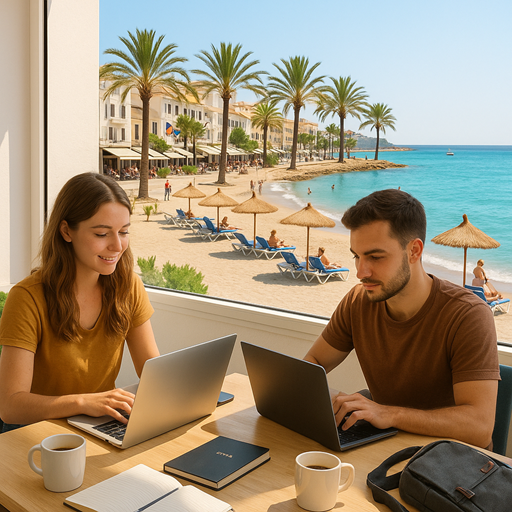

Spain Digital Nomad Visa (Digital Nomad Residence Permit)

If you’re searching for digital nomad visa Spain, Spain digital nomad visa, or nomad visa Spain, you’re likely asking the same practical questions: Am I eligible? How much income do I need? Can I apply from within Spain or do I need a consulate? How long will it take? And what happens with taxes and social security?

We explain the two application routes (Spain vs consulate), provide refusal-proof documentation standards (including a practical employer letter template structure), clarify income threshold logic, and walk you through what happens after approval (TIE/biometrics, timelines, and compliance). If you want to apply for Spain’s digital nomad visa with expert support, this is the “can you help me + what will it take + what’s the process” resource.

Who this is for: Non-EU remote workers, employees of foreign companies, freelancers with international clients, and founders/contractors who can prove ongoing professional activity and stable income—while meeting Spain’s documentation and compliance standards.

Important note: This page focuses on practical execution and general guidance. Tax and social security outcomes depend on your facts; we include a concise “tax reality” module and recommend a tailored review for high-stakes tax planning.

The Digital Nomad Visa for Spain, introduced through the Law to Foster the Startup Ecosystem (commonly called the Startup Law), allows remote workers and freelancers to establish themselves in Spain. It is designed to attract international talent and makes Spain a strong option for remote professionals who want legal residence while continuing to work remotely.

Index

At-a-glance: Spain Digital Nomad Visa

Who it’s for (employee / freelancer / business owner)

The Spain digital nomad visa (also called the international telework authorization when applying from Spain) is aimed at non-EU citizens who can prove they work remotely using digital tools. Typical profiles include:

  • Employees of foreign companies authorized to work remotely from Spain.
  • Freelancers / contractors working for one or multiple foreign clients.
  • Founders or business owners who provide services remotely and can document the business activity and income flow.

Key benefits (residence length, family, travel basics)

Why this is one of the most searched “remote work visa” options in Europe:

  • Legal residence + work authorization aligned with remote work.
  • Two application paths: apply from your home country via consulate (visa) or apply from within Spain (residence authorization route).
  • Family members can be included (spouse/partner, dependent children, and in some cases dependent ascendants), with work rights for eligible dependents of working age.
  • Clear renewal pathway if you keep meeting conditions, and a route that can support long-term residence planning.

What is the Digital Nomad Visa for Spain?

The Spain digital nomad visa allows eligible non-EU citizens to reside in Spain while working remotely either as an employee for a foreign company or as a self-employed professional serving primarily foreign clients. It is important to distinguish “visa” language (consulate route) from the residence permit for international telework (in-Spain route): both are part of the broader digital nomad residence framework, but the filing channel and post-approval steps differ.

One practical advantage is planning: the time you reside legally in Spain under this status may support longer-term residence objectives, including eligibility paths linked to lawful residence continuity (always subject to meeting all legal requirements in your specific case).

Eligibility & Requirements (2026-ready)

Basic eligibility checklist

To qualify for the Spain digital nomad visa requirements, applicants typically need to show:

  • Non-EU nationality (this route is designed for third-country nationals).
  • Remote work capability (your work can be performed using electronic/telematic means, not physically tied to Spain).
  • Established professional relationship with the foreign company/client(s) before applying (a common standard is showing a stable relationship prior to filing).
  • Company activity duration for employees: the company is typically expected to have been operating for a minimum period (commonly one year) to prove real business activity.
  • Professional qualification or experience (e.g., relevant degree/certificate or multi-year experience in the same field).
  • Legal presence if applying from within Spain: you cannot be in Spain illegally at the time of application, but you may apply while you are in Spain legally (for example as a tourist, student, or other valid status), depending on your route and circumstances.
  • Criminal record compliance and sufficient financial means.
  • Health insurance meeting acceptance standards.

Execution tip: Eligibility is not just about “having a job.” Most refusals come from documentation proof standards—how your remote work, income, and legal compliance are evidenced.

Differences Between the Digital Nomad Visa and Residency in Spain

Income requirement (how much income do you need?)

One of the most searched questions is: How much income do you need for Spain’s digital nomad visa? In practice, authorities expect proof of a stable income that meets a minimum threshold tied to official reference amounts. Many public summaries describe this as needing to prove income around 200% of a reference index for the main applicant, plus additional percentages for dependents.

How we handle this in a case review: We calculate the threshold for your household composition (main applicant + each dependent), then map the best evidence sources (payslips, invoices, contracts, and bank statements) to show both amount and stability. The strongest applications demonstrate consistent income across multiple months and clear continuity going forward.

Remote work rules (foreign employer/clients + Spanish clients clarity)

A key compliance point is that your work should be primarily for a foreign employer or foreign clients. Some summaries state that limited professional activity with Spanish clients may be possible up to a percentage cap. If you plan to invoice Spanish clients, your strategy and evidence should be reviewed carefully to avoid route mismatch or compliance risk.

Differences Between the Digital Nomad Visa and Residency in Spain

Many applicants confuse “visa” and “residence.” Here’s the practical distinction:

  • Consulate route (Digital Nomad Visa): you apply at the Spanish consulate in your country of nationality or legal residence. The visa is typically issued for a limited period (commonly up to one year) and is used to enter Spain under the digital nomad framework.
  • In-Spain route (Digital Nomad Residence Permit / International Telework Authorization): you apply from within Spain while you are legally present. This route typically grants a longer initial residence authorization (often up to three years), renewable if you maintain the requirements.

Why this matters: the documentation is similar, but timelines, filing mechanics, and post-approval steps differ. Choosing the right path can reduce delays and simplify your transition into Spain.

How the Application Works (Two Paths)

Decision tree: apply from Spain or consulate?

This is one of the highest-intent questions: Can I apply for Spain’s digital nomad visa while in Spain? In many cases, yes—if you are in Spain legally and meet the requirements, the in-Spain route can be a strong option. Use this practical decision framework:

  • You are outside Spain → the consulate route is typically the starting point.
  • You are in Spain legally (tourist/student/other valid status) and you meet the requirements → the in-Spain route may be available and can simplify the transition to a longer residence authorization.
  • You are not in Spain legally → you generally must regularize your situation first; filing while irregular is a major risk and often not viable.
  • Your documents are not ready (criminal record timing, apostille/translation pending, unclear employer letter) → consider delaying filing until your evidence pack meets “refusal-proof” standards.

Apply from your home country (consulate route)

If applying from abroad, you submit the visa application to the Spanish consulate with your full documentation pack. Consulates often focus on formalities (apostilles/legalisation, sworn translations), identity, and whether your remote work arrangement is clearly authorized and stable.

What we do: ensure the consular pack is consistent, properly formalized, and includes clear proof of remote work authorization and income stability—two areas that frequently trigger additional requests.

Apply from within Spain (UGE route)

If applying from Spain, you file the international telework residence permit while legally present. This route is often used by applicants already in Spain who want a streamlined transition to a longer residence authorization.

What we do: we validate your legal entry/status timing, verify eligibility, and structure the evidence so the authority can quickly verify compliance (remote work, income threshold, insurance, criminal record, and social security plan).

Application from Spain

If you include family members in the same filing, you may need relationship and dependency documents in addition to the core remote-work documentation. This is often where applicants lose time due to missing civil status formalities or unclear dependency evidence.

  1. Documents proving the relationship with the applicant (birth or marriage certificates)
  2. Criminal record certificate from the places of residence over the past 2 years
  3. Proof of dependency on the applicant if they are parents or children over 21 years old

Documents You’ll Need (with refusal-proof standards)

Competitors often provide generic checklists. What applicants actually need is clarity on what “good evidence” looks like and which documents commonly cause refusals. Below is a practical documents framework for Spain digital nomad visa documents checklist, including proof standards and common pitfalls.

Benefits of the Digital Nomad Residency in Spain

Required Documentation for Digital Nomad Visa:

La siguiente documentación será requerida igualmente para la obtención tanto del visado como la residencia de teletrabajador en España:

Documentación Requerida nomaddigital:

  1. Passport:
    • Valid passport (original and full copy of all pages). Consistency of name spelling across documents is essential.
  2. National Identity Document (DNI):
    • Where applicable for the consulate jurisdiction: proof of legal residence/ID within the consulate’s territory. Requirements vary by consulate and nationality.
  3. National Visa Application:
    • Complete and signed copies of the national visa application form (consulate route).
  4. Foreign Identification Number (NIE):
    • NIE mechanics can differ by route. If a consulate requires a NIE step or local forms, follow that consulate’s instructions precisely.
    • Complete and sign EX15 when applicable.
    • Complete and sign Form 790-012 when applicable.
  5. Visa and/or Residency Fee:
    • Fees vary by consulate route. If applying from Spain, follow the applicable fee model (often referenced as 790-038 in some guides). Always confirm the current amount and payment method at filing.
  6. Proof of Financial Means:
    • Show income above the minimum threshold for the main applicant and additional dependents. The strongest proof includes consistent monthly income plus contract/invoice evidence that supports ongoing continuity.
    • Provide one or more of the following, depending on your profile:
      • Employment contract and payslips (employees).
      • Client/service contracts and invoices (freelancers/contractors).
      • Bank statements showing income receipt over multiple months.
  7. Proof of Employment or Professional Relationship:
    • Evidence of at least three months of employment/professional relationship with the foreign company or foreign clients, as required by your scenario.
    • Employer letter (employees) — refusal-proof standard: the letter should clearly authorize remote work from Spain and include role details, remote modality confirmation, relationship start date, salary, and continuity. If not originally in Spanish, provide a sworn translation when required.
    • Client letters/contracts (freelancers) — refusal-proof standard: include scope of services, remote nature, contract duration, payment terms, and evidence that clients are primarily outside Spain.
  8. Proof of Business Activity:
    • Proof that the foreign company has been operating for the minimum required period (often one year), supported by registry documents, incorporation certificates, or equivalent official evidence.
  9. Social Security Registration in Spain:
    • Self-employed: commitment to comply with Spanish social security obligations before starting professional activity, where required.
    • Employees: proof of coverage through the appropriate channel (Spanish registration or applicable coverage certificate when relevant).
  10. Qualifications or Professional Experience:
    • Diplomas/certificates or proof of at least three years of professional experience in similar functions. For regulated professions, recognition requirements may apply.
  11. Health Insurance:
    • Insurance must meet acceptance standards. Private insurance (when required) should typically be with an authorized provider in Spain, without waiting periods, and provide full medical coverage for the intended residence period.
    • Many applicants are refused due to insufficient insurance wording. The policy should clearly match the coverage expectations used in practice.
  12. Criminal Background Certificate:
    • A properly issued criminal record certificate covering the relevant period, issued recently and meeting formalities (apostille/legalisation where applicable) and sworn translation where required.
  13. A sworn statement declaring no criminal record in the last five years.Penales:
    • Ensure your criminal record evidence and declarations are consistent and cover the required timeframe. Many delays happen due to mismatched dates, missing legalisation/apostille, or expired certificates.

Proof of Remote Work (Employer letter template structure)

If there is one document that repeatedly makes or breaks a file, it is the remote work authorization letter (employees) or the client contract package (freelancers). Here is the structure we recommend to make it “decision-ready” for the officer reviewing your file:

  • Identity and role: your full name, job title, and a brief description of duties.
  • Remote modality confirmation: explicit permission to work remotely from Spain using electronic tools.
  • Relationship start date: confirm you have been working with the company/client for the required minimum period before filing.
  • Compensation: salary/fees and payment periodicity.
  • Continuity: confirm the relationship is ongoing and expected to continue during the residence period.
  • Company details: legal name, registration number, country, and confirmation of business activity duration.

Why this matters: Most refusals are not about eligibility but about unclear documents. A clear letter and consistent evidence pack reduces “requests for additional documents” and improves approval speed.

Apostille & sworn translations (what commonly trips applicants up)

Foreign-issued documents often need apostille/legalisation and sworn translation. The common failure points are: (1) documents issued by the wrong authority, (2) missing apostille/legalisation, (3) translations that are not sworn when required, and (4) certificates expiring before filing. Planning formalities upfront is one of the biggest ways to reduce delays.

Health insurance requirements (what is accepted)

Insurance is frequently underestimated. You must show coverage that meets the acceptance standard used in practice: full medical coverage in Spain for the intended period, without gaps or problematic exclusions. If private insurance is needed, it should typically be contracted with an authorized provider in Spain and clearly documented.

Family / Dependents

Digital Nomad Family Members in Spain

If your application is approved, your spouse or dependents can join you during your stay in Spain. Family applications can be filed together with the main applicant or later, depending on timing and strategy.

Family members who obtain digital nomad residency and are of working age are typically granted work authorization, allowing employment or self-employment—subject to the specific terms issued in their authorization.

Documentation for Digital Nomad Family Members:

Family inclusion is a major conversion question because it affects income thresholds and documents. Expect to add relationship documents and, where applicable, dependency proof.

  1. Proof of Relationship with the Applicant: civil status documents (marriage/birth certificates) properly formalized and consistent with passports.
  2. Criminal Background Certificate:
    • A criminal background certificate from the countries where the family member has lived in the last two years, meeting formalities and translation standards.
  3. Proof of Dependency:
    • If the family members are parents or children over 21 years old, provide objective proof of dependency (financial support, lack of independent means, and continuity).

Extra income + common pitfalls

Adding dependents increases the required income threshold and often increases document formalities risk (apostilles and sworn translations for civil status documents). The most common pitfalls are outdated certificates, inconsistent names, and missing dependency evidence for parents or adult children.

Benefits of the Digital Nomad Residency in Spain

Applying for the residence and work permit as a digital nomad in Spain offers several notable benefits:

  1. Time of Residence Counted for Nationality:
    • Lawful residence time can support longer-term residence planning. After 5 years of continuous lawful residence, many residents explore long-term residence options, subject to meeting all requirements.
  2. Path to Spanish Nationality:
    • This period of residence may support eligibility for Spanish nationality by residence when the relevant legal residence periods are met (which vary by nationality), and when all other naturalization requirements are satisfied.
  3. Application from Spain:
    • You can begin the application process while in Spain legally (including as a tourist in many scenarios), and documentation can often be submitted online depending on the route.
  4. You Can Invoice:
    • Some public summaries indicate a limited allowance to invoice Spanish clients up to a cap (often cited as 20%) while maintaining the remote-work nature of the authorization. If you plan Spanish clients, confirm strategy carefully.
  5. Additional Benefits:
    • Temporary Stay Abroad:
      Depending on your residence conditions, temporary stays outside Spain may be allowed without automatically cancelling your status, but long absences can impact renewals and long-term planning.
    • Family Residency:
      Your spouse/partner and eligible dependents can join you, often with work authorization for dependents of working age.
    • Initial Permit and Renewals:
      Many applicants obtain an initial residence authorization (often up to 3 years when applying from Spain) and renew if conditions are maintained, supporting longer-term residence planning.

Processing Times, Fees & Total Cost

How long does it take to get a Spain digital nomad visa?

Processing time is one of the biggest decision factors. Timelines vary by route:

  • In-Spain route (international telework residence permit): often processed quickly compared to standard immigration routes because it is typically managed by the UGE framework. A complete file can significantly reduce delays.
  • Consulate route (visa): consular processing times vary by location and appointment availability. A refusal-proof pack reduces “extra document requests,” which are a major delay driver.

Reality check: “Fast” timelines are only realistic when the evidence is clear. Most slowdowns come from unclear employer letters, inconsistent income evidence, or formalities (apostille/translation) issues.

Government fees + typical extra costs

Costs are usually made up of: (1) government fees (which vary by route), (2) document costs (criminal records, civil certificates), (3) apostille/legalisation, and (4) sworn translations. Many applicants also pay “twice” when documents expire and must be re-issued—planning prevents that.

Your service packages (what’s included)

Our support is designed around speed + refusal prevention:

  • Eligibility review (route selection: apply from Spain vs consulate; profile fit: employee vs freelancer vs founder).
  • Income threshold calculation for main applicant + dependents, with evidence mapping.
  • Document pack build (including employer/client letter structure guidance and proof-of-remote-work standards).
  • Formalities coordination (apostille/legalisation and sworn translations planning).
  • Submission support + follow-up and responses to additional document requests.

Taxes & Compliance (Practical Overview)

Tax residency triggers (183 days + real-world scenarios)

Tax is one of the most misunderstood parts of the Spain digital nomad visa. A common rule of thumb is that spending around 183 days in Spain within a year can trigger tax residency, but your tax situation depends on multiple factors (center of economic interests, family circumstances, and treaty interactions). This is why a short tax review can be valuable—especially for high earners or mixed-income profiles.

Beckham Law: when it may apply + when it won’t

Many competitors market the visa as a “tax deal.” The reality is more nuanced. Some digital nomads may be eligible to opt into a special tax regime often discussed under the Beckham Law context, but eligibility depends on your situation and how you move to Spain. It is essential to confirm whether you qualify and which income types are covered before making decisions based on headlines.

Social security basics (employee vs freelancer)

Social security requirements differ significantly between employees of foreign companies and freelancers. Some applicants must demonstrate coverage through an appropriate channel, while others must commit to registering and contributing in Spain. Getting this right is not optional—mismatched social security evidence is a common reason for delays.

Tax Benefits of the Digital Nomad Visa

The Digital Nomad Visa is often associated with attractive tax messaging. However, tax outcomes depend on your residency status, your income types, and whether you qualify for a special regime. The visa can be applied for either from the country of origin or directly from Spain, but your tax planning should be aligned with the route and your personal facts.

Some digital nomads may opt to be taxed under a special regime discussed in connection with the Non-Residents Income Tax (IRNR) and commonly referenced as the Beckham Law, while others may be taxed under the regular IRPF resident system. For mixed-income profiles (employment + dividends + rentals), the “best” option is not always the one with the lowest headline rate.

Double taxation agreements can be relevant depending on your home country and income sources. Professional tax advice is strongly recommended for accurate planning.

Applying the Beckham Law as a Digital Nomad in Spain

Digital nomads who opt into a special regime may access benefits such as a flat rate on certain income types and simplified reporting for foreign assets—subject to eligibility and compliance. Always confirm your eligibility before relying on these benefits.

  • Fixed Tax Rate (often cited in public summaries): some sources describe a flat rate such as 24% on certain labour income up to a threshold, with a higher rate beyond. The exact scope and eligibility must be confirmed for your case.
  • Foreign asset reporting differences: some regimes reduce certain foreign asset reporting obligations compared to standard resident taxation, depending on status.
  • Wealth tax scope: treatment can vary; confirm your specific exposure based on where assets are located and which regime applies.
Requirements for the Digital Nomad Visa to Benefit from IRNR under the Beckham Law as an International Teleworker

To qualify under any special regime, certain requirements must be met. Always verify current requirements and how they apply to your profile (employee vs freelancer, prior residency history, and the nature of your income).

  1. Previous Residency: many summaries reference a requirement to have lived outside Spain for a defined prior period before applying for the regime.
  2. Income structure: your income should generally align with the regime’s eligibility rules (especially around “permanent establishment” concepts for business income).
  3. International Telework Status: the move to Spain should be supported by your telework authorization and properly documented remote-work conditions.
  4. Family: in some scenarios, spouse and eligible children moving with you may also be considered under the same framework, subject to eligibility rules.
Important Considerations

Tax compliance must be aligned with your immigration status and your real living pattern in Spain. If you expect to spend most of the year in Spain, plan your tax position early rather than after approval.

To ensure compliance and maximize benefits, it is advisable to seek the advice of specialists in international taxation. Proper guidance can guarantee that all conditions are met correctly, avoiding problems and optimizing your tax burden.

Some special tax statuses may be time-limited. Plan for what happens after the special period ends.

Best Places to Live in Spain as a Digital Nomad:

  • Attractive Cities: Barcelona, Madrid, and Valencia are popular options for digital nomads due to coworking ecosystems, transport, and international communities.
  • National Network of Welcoming Villages: Some rural initiatives aim to attract remote workers with lower living costs and lifestyle advantages.

Is It Possible to Work in Spain with This Visa?

Is It Possible to Work in Spain with This Visa

Yes. The Spain digital nomad visa is specifically designed to allow you to work remotely while living in Spain—either as an employee of a foreign company or as an independent professional serving foreign clients. Some public summaries state that limited work with Spanish clients may be allowed within a cap (often cited as up to 20%), but your compliance strategy should be reviewed if Spanish clients are part of your plan.

This documentation is essential to ensure that your digital nomad residence application in Spain is processed correctly and efficiently.

Procedure

Where to Apply for the Digital Nomad Visa?

Digital Nomad Visa Spain: Where to Apply?

  • From Abroad: If you are outside of Spain, you will need to apply at the Spanish consulate in your home country or the country where you have legal residence. The digital nomad visa Spain is often issued for a limited initial period and allows entry so you can live in Spain under the telework framework.
  • From Spain: If you are already in Spain legally (for example, on a student visa or as a tourist), you can apply for the residence permit for international telework. This route is a common choice for applicants already in Spain who want a streamlined transition to a longer residence authorization.

How long does it take to resolve the Digital Nomad Residency?

Processing speed is one of the main benefits of this route. Many applications are handled through frameworks associated with the UGE, which can be faster than standard immigration procedures. However, speed depends heavily on whether your documentation is complete and refusal-proof.

  1. Residency Application from Spain: In many cases, decisions are issued within a relatively short period, commonly described as around 20 business days for certain in-Spain applications, depending on circumstances and completeness of the file.
  2. Digital Nomad Visa (consulate): Consular timelines vary by location and appointment availability. Some public summaries cite short processing targets, but real timelines depend on local consulate workload and whether additional evidence is requested.

After Approval: TIE, Biometrics & Next Steps

Many guides don’t explain what happens after you’re approved. Here’s the practical sequence most applicants need to plan for:

  • Entry (if consulate route): enter Spain within the visa validity and keep proof of entry.
  • Biometric appointment (toma de huellas) and TIE: book your appointment, submit the TIE file, and obtain your physical residence card. Appointment availability can be a bottleneck in some cities.
  • Social security alignment: ensure your coverage or registration is consistent with your profile (employee vs freelancer) and your documentation.
  • Ongoing compliance: maintain income, remote-work relationship, and insurance during the residence period to support renewals.

Common Refusal Reasons (and how we prevent them)

Most refusals happen because the file is unclear or inconsistent—not because the applicant is fundamentally ineligible. We build a refusal-resistant application by checking the most common failure points:

  • Employer letter too vague: missing explicit permission to work remotely from Spain, missing start date, missing continuity confirmation, or unclear salary/payment terms.
  • Income proof not “stable”: statements show irregular income without explanation, missing invoices/contracts, or insufficient months of evidence.
  • Criminal record formalities: wrong certificate scope, expired certificate, missing apostille/legalisation, or missing sworn translation.
  • Insurance not accepted: policy wording doesn’t match expected standards (coverage gaps, exclusions, waiting periods, or non-qualifying provider depending on route).
  • Social security mismatch: employee/freelancer evidence does not align with how you will be covered while living in Spain.

The Law Regulating Remote Work

Spain’s framework for attracting international talent has evolved over time. The Startup Law expanded pathways for remote workers and includes the digital nomad residence mechanism, enabling non-EU citizens to live in Spain while carrying out remote work activities, subject to meeting the legal requirements and documentation standards.

Date of Entry into Force

The Startup Law and the Spain digital nomad visa came into effect in 2023. Applicants can apply either from their home country via the consular route or from within Spain via the in-country residence authorization route, depending on circumstances.

Alternatives to the Digital Nomad Visa

If you do not meet the requirements for the digital nomad visa Spain, other options may exist depending on your profile: student residence, internships, highly qualified professional pathways, entrepreneurship routes, research permits, or other work/self-employment authorizations.

The Non-Lucrative Residence Permit is another popular option, but it is not designed for remote work and typically requires proving sufficient funds to live in Spain without working. If you need the ability to work, the digital nomad route or other work-based permits may be more suitable.

Digital Nomad Visa vs Non-Lucrative Visa (Quick Comparison)

One of the most common comparison searches is Spain digital nomad visa vs non lucrative visa. The short version:

  • Digital Nomad Visa: built for remote work; requires remote-work proof, income threshold evidence, and compliance documentation.
  • Non-Lucrative Residence: designed for living in Spain without working; requires higher savings/means proof and does not fit applicants who need to actively work while residing in Spain.

Questions and Answers about Digital Nomad Residency in Spain

The Spain digital nomad visa offers the ability to live in Spain while continuing remote work for foreign companies or clients. Because the process is documentation-heavy and the “apply from Spain vs consulate” decision changes strategy, most applicants benefit from an eligibility review and a refusal-proof document pack before filing.

Our law firm specializing in Spain Digital Nomad Visas is available to advise and guide you throughout the entire application process—from eligibility and document strategy to submission and post-approval steps. Contact us for an eligibility review and application support.

FAQ (must-answer questions)

  1. What are the requirements for the Spain digital nomad visa? You generally need to be a non-EU remote worker, prove an established professional relationship with a foreign company/client(s), meet the income threshold, show acceptable health insurance, provide criminal record documentation meeting formalities, and prove your work can be done remotely from Spain.
  2. How much income do you need for Spain’s digital nomad visa? Applicants must prove stable income meeting the minimum threshold for the main applicant plus additional amounts for dependents. We calculate the threshold for your household and map the strongest proof (contracts + payments + bank statements) to demonstrate stability.
  3. Can I apply for Spain’s digital nomad visa while in Spain? In many cases, yes—if you are in Spain legally, you can apply for the in-Spain international telework residence permit route. Route selection depends on your status, timing, and document readiness.
  4. How long does it take to get a Spain digital nomad visa? Timelines vary by route and the completeness of your file. In-Spain applications are often described as fast when handled through the appropriate framework; consular timelines vary by location and appointments. Clear, refusal-proof documentation is the best way to avoid delays.
  5. How are taxes handled on Spain’s digital nomad visa? Tax depends on your days in Spain, your personal and economic ties, and whether you qualify for any special regime discussed under the Beckham Law context. Many applicants should seek tailored tax advice to confirm the best and compliant option for their profile.
  6. Can I include my family in the Spain digital nomad visa application? Yes, family can usually be included (spouse/partner and dependents). You must prove additional income and submit civil status documents with required formalities.
  7. Can I work for Spanish companies with the digital nomad residency? Many summaries describe limits on Spanish clients/activity. If you plan to work with Spanish clients, confirm your compliance strategy carefully to avoid route mismatch.
  8. Do I need health insurance? Yes. You must show insurance that meets acceptance standards. Private insurance is frequently required when public coverage is not applicable.
  9. What happens after approval? You typically complete TIE/biometrics steps (fingerprints appointment), align social security coverage, and maintain ongoing compliance for renewals.