
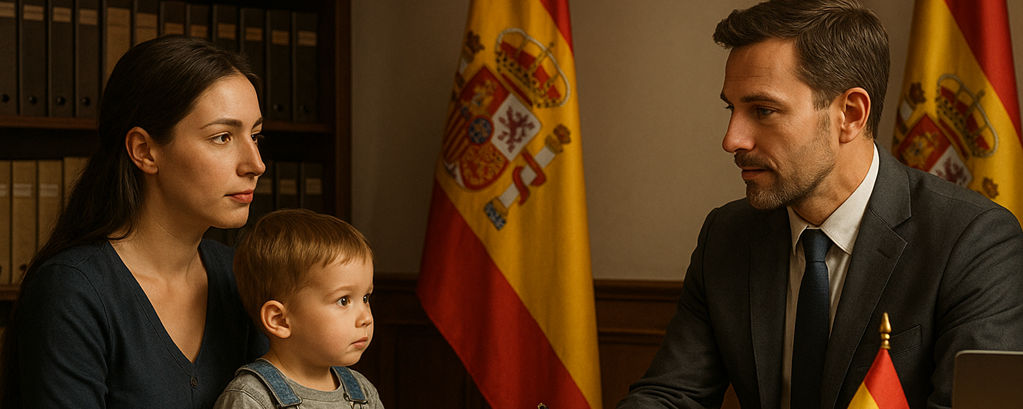
If your child was born abroad and is living with you in Spain, you can apply for their own residence authorization so they can stay legally as part of your family. This is a different procedure from the one for children born here, and it has its own clear requirements: the child must have been in Spain long enough, and you, the resident parent, must show you can support and house them. This page explains, in plain English, exactly who qualifies, the documents, the process, and — importantly — a temporary 2026 measure that makes it dramatically easier for many families right now.
The legal basis is article 160 of Real Decreto 1155/2024 (the immigration regulation in force since 20 May 2025), with the family reunification rules of articles 65–71 behind it. The route is the companion to the one for children born in Spain (article 159); the difference is that a child born abroad must prove a period of residence here first.
The quick answer
Yes, a child not born in Spain can obtain residence — they do not need to leave and apply from abroad. Under article 160, a foreign minor (the unmarried, biological or adopted child of a parent who is a legal resident in Spain) can be granted a five-year residence authorization, provided they have lived continuously in Spain and the parent meets the means and housing requirements. When the child reaches working age (16), the authorization also lets them work with no further procedure. The key, as always, is selecting the correct route and building a file Extranjería can approve without asking for corrections.
An important 2026 measure: the requirements are temporarily relaxed
Before the standard requirements, this is the news that changes the picture for many families. As part of the 2026 extraordinary regularization (introduced by RD 316/2026), until 30 June 2026 applications under article 160 — filed alongside a parent’s regularization, or where the parent already holds a residence authorization — are exempt from the usual two-year residence requirement and from the means-and-housing proof. Instead, the child only needs to show five months of continuous residence in Spain. The child’s application can be filed at the same time as the parent’s, without waiting for the parent’s case to be decided.
This is a major simplification, and it is time-limited. If your situation might fit, the timing matters — which is exactly the kind of window where acting early, with the file correctly assembled, makes the difference. Below we explain both the relaxed path and the standard requirements that apply outside it.
The standard requirements (outside the 2026 measure)

When the temporary measure does not apply, article 160 sets these conditions:
- At least one parent is a legal resident in Spain. Both parents do not need to be residents — one is enough to start the child’s process.
- Two years of continuous, uninterrupted residence of the child in Spain immediately before the application, proved mainly through the historical padrón (empadronamiento histórico). This is why registering the child as soon as they arrive — and keeping it consistent — is so important.
- Sufficient financial means. The resident parent must show income to support the family, measured against the reunification thresholds — 150% of the IPREM for a two-member unit (parent plus child), roughly €10,800–€11,000 a year, with more for each additional member.
- Adequate housing, evidenced by a housing suitability report from the town hall (see below).
- The child is non-EU (a child under the EU regime follows a different route — the family member card).
- School enrolment proof if the child is of compulsory schooling age.
The application can be filed while the parent’s own residence authorization is still being processed — you do not have to wait for the parent’s card to be in hand.
Proving the parent’s means
How you prove means depends on the parent’s situation, and a strong file tells a clear financial story rather than just attaching papers:
- Employed: employment contract, recent payslips, and the latest income tax return to show stable income.
- Self-employed: evidence of activity and solvency, with the prior year’s income tax return.
- Not working but with funds: a bank certificate and account evidence showing the required, traceable funds.
Worth noting: current practice and case law require Extranjería to weigh the family’s overall situation rather than refuse automatically on a means shortfall, especially where the child is schooled and integrated. But the safest file still documents means clearly.
Custody and the other parent’s consent
One of the most common questions is whether one parent can apply without the other. The answer: yes, but if only one parent is the resident applicant and the other parent lives abroad or does not reside with the child, you generally need the other parent’s consent for the child to live in Spain — typically a declaration executed before a Spanish consulate or a notarized, legalized authorization. The exceptions are where the applying parent holds sole custody or there is a court authorization, in which case you provide the documents proving that. This is a frequent refusal trigger when handled loosely, so it should be treated as a core part of the file, not an afterthought.
The housing suitability report

Where the standard route applies, the family must show adequate housing. The report is requested from the town hall (or the autonomous community), and an official assesses whether the home meets the conditions for the child to live there with the family. To prepare it you typically provide the rental contract or property deed, the latest payment receipt, and a utility bill (water or electricity). The town hall has 30 working days to issue it; if it does not, you can prove adequacy by other means referencing the occupancy title, number of rooms, use, occupants, and habitability. Because this step takes time, requesting it early — while your two-year residence evidence is already in place — keeps it from becoming the bottleneck.
Documents
- Form EX-01, in duplicate, completed and signed by the father, mother, or legal guardian.
- Full copy of the child’s valid passport or travel document.
- Birth certificate proving the parent-child relationship (or guardianship documents).
- Applicant’s ID: DNI if the guardian is Spanish, or the residence card if the parent is foreign.
- Historical padrón proving the child’s two years of continuous residence (or five months under the 2026 measure).
- School enrolment certificate if the child is of schooling age.
- Proof of the parent’s financial means (per the situation above), where required.
- Housing suitability report, where required.
- Consent of the other parent, or proof of sole custody / court authorization, where applicable.
- Proof of the fee (model 790, code 052, heading 2.1.5).
Foreign documents must be apostilled or legalized and, where not in Spanish, accompanied by a sworn translation (traducción jurada). The most common failure points are a missing apostille, a non-accepted translation, or names and dates that do not match across documents — which is why the file should be reviewed as a single, consistent bundle.
How to apply, step by step
- Confirm the route. Check whether you fall under the 2026 relaxed measure or the standard two-year route, and whether a nationality path might fit better.
- Assemble the file: the child’s identity and relationship documents, the residence evidence (padrón), means and housing where required, and any consent/custody documents — with apostilles and sworn translations sorted.
- File the EX-01 at the Immigration Office (Extranjería) for the child’s province, in person or online with a digital certificate or through a professional, and pay the 790-052 fee.
- Respond to any subsanación (request for corrections) within the 10-day deadline to avoid the file being archived.
- After a favourable decision, complete the TIE: the child’s residence card, with fingerprints, at the police station.
The application is filed with Extranjería; the TIE stage is handled by the National Police. The official resolution deadline is short under the regularization framework (one month for simultaneous filings), though ordinary cases can take longer depending on the office; administrative silence means the application is understood as rejected. A complete, well-structured file is the single best way to keep things moving and avoid a refusal on procedural grounds.
Which route is really yours
Route selection is where most cases are won or lost. A quick orientation:
- Parent is a non-EU legal resident → this article 160 route (or family reunification under articles 65–71). The child’s residence follows the parent’s lawful status.
- Parent is EU/EEA/Swiss → not this route at all. The child falls under the EU regime — see the EU family member card.
- Parent is Spanish → a nationality path may be the better first step, with residence used to protect the child’s stay meanwhile.
- Child was born in Spain → a different procedure entirely; see residence for a minor born in Spain (article 159, with a five-year permit and a six-month deadline).
- Parents are not yet legal residents → they usually need to regularize first, often via arraigo social, with the child’s application filed simultaneously under the 2026 measure where it applies.
For the parents’ own family-based options, see our family reunification guide.
How we help
The decisive work here is route selection, the consent/custody strategy, and a clean document bundle. Lexmovea confirms whether you fall under the 2026 relaxed measure or the standard two-year route (or a nationality-first strategy); structures single-parent and shared-custody cases so they don’t fail on a missing authorization; checks every apostille, legalization, and sworn translation for cross-document consistency; coordinates the housing report so it doesn’t delay filing; submits with Extranjería; handles any subsanación; and guides the child’s TIE afterwards. We work in English throughout, and we know how much rides on it — schooling, healthcare, and travel all depend on getting the child’s status right.
If your child was born abroad and is with you in Spain, contact Lexmovea. Send us the child’s passport, your residence card, and the padrón, and we’ll confirm the route — including whether the 2026 window applies to you — and the exact plan.
Frequently asked questions
Can a child not born in Spain get residency?
Yes, without leaving the country. Under article 160 of RD 1155/2024, a foreign minor who is the child of a legal resident in Spain can be granted a five-year residence authorization, provided they have the required period of residence here and the parent meets the means and housing conditions.
How long must the child have lived in Spain?
Two years of continuous, uninterrupted residence before the application, proved through the historical padrón. But until 30 June 2026, a temporary measure reduces this to five months for applications filed alongside a parent’s regularization or by parents who already hold residence.
What documents are required?
Form EX-01, the child’s passport, the birth certificate proving the relationship, the applicant parent’s ID or residence card, historical padrón, school enrolment if applicable, proof of means and housing where required, any consent or custody documents, and the 790-052 fee. Foreign documents need apostille or legalization and a sworn translation.
Do both parents need to apply, or live together?
No. One resident parent is enough, and the parents need not live together. But if the other parent is abroad or not living with the child, you generally need their consent (consular or notarized) unless the applying parent has sole custody or a court authorization.
How much money does the parent need to show?
Under the standard route, the reunification threshold of 150% of the IPREM for a two-member unit (parent plus child) — roughly €10,800–€11,000 a year — with more for each additional member. Under the 2026 measure, the means requirement is waived.
Where do I apply, and how long does the authorization last?
The application is filed with Extranjería (the Immigration Office) for the child’s province; the TIE card stage is handled by the National Police. The authorization lasts five years, and once the child turns 16 it allows them to work without any further procedure.
Is this the same as for a child born in Spain?
No. A child born in Spain follows article 159 — a five-year permit with a six-month deadline and no two-year residence requirement. A child born abroad follows article 160, which requires the period of residence and the means and housing proof (subject to the 2026 relaxation).
Do I need apostille and sworn translation?
Yes. Foreign civil documents need apostille or consular legalization depending on the issuing country, and a sworn translation where they are not in Spanish. Confirming this before filing avoids documents being rejected and the case delayed.