
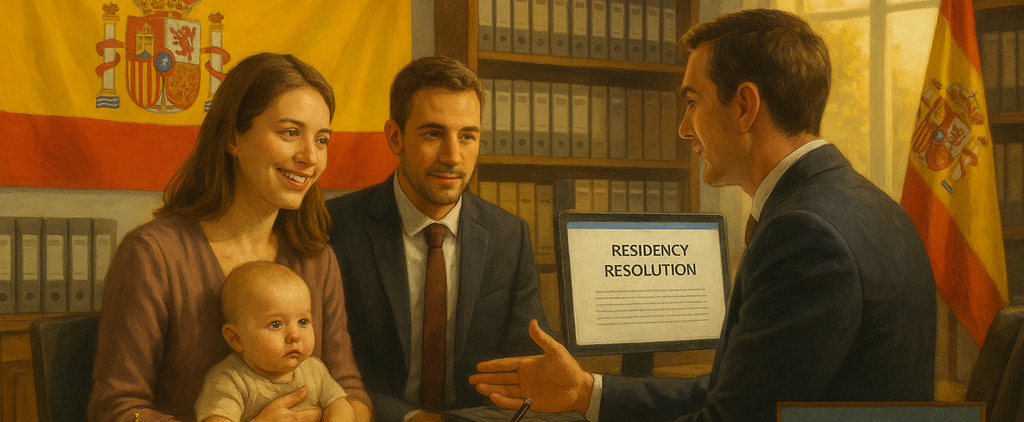
If you are a foreign national legally resident in Spain and your child was born here, your child does not automatically become Spanish — but they are entitled to their own residence authorization, and Spanish law now grants it generously. Under the 2024 immigration reform, a minor born in Spain to a resident parent receives a five-year residence authorization, with no visa required. This page explains, in plain English, exactly how it works, the deadline you must not miss, the documents, what happens if you apply late, and how it differs from nationality.
The legal basis is article 159 of Real Decreto 1155/2024 (the immigration regulation in force since 20 May 2025), with Organic Law 4/2000 behind it. This replaced the old rule (article 185 of the now-repealed RD 557/2011), and the change matters: there is now a fixed five-year permit and a clear deadline to apply.
The quick answer: born in Spain is not automatic citizenship
This is the misconception to clear up first. Spain does not grant nationality simply because a child is born on its soil. What a child born here to a foreign resident parent gets is a residence authorization — the legal right to live in Spain — not a Spanish passport. For most families the immediate, practical step is this residence permit (and the TIE card that follows). A nationality route may exist later, and in some cases sooner, but they are different procedures with different authorities, and confusing them costs months.
What your child gets, and the deadline that matters
Article 159 grants a temporary residence authorization valid for five years from the date of the decision, with no visa required. It is available to a foreign minor, the unmarried biological or adopted child of foreign parents who hold any residence authorization under the regulation. A useful detail: when the child reaches working age, the authorization allows them to work without any further administrative step.
The crucial new rule is the deadline. The parent must apply within six months — counted from the child’s birth, or from the date a parent obtains residence if that comes later — and the child must be in Spain and not have left the country since birth. This six-month window did not exist under the old regulation, and missing it changes the route entirely, as explained below.
What happens if you miss the six-month window
If the application is not filed within the six months, or the child has left Spain since birth, the case no longer fits article 159. Instead it must be processed as a family reunification, which means meeting the requirements of article 67 of the regulation — including proof of adequate housing and sufficient financial means. That is a heavier file, so the six-month deadline is genuinely worth protecting.
There is, however, a safety valve. The Directorate-General for Migration (DGGM) has issued internal guidance allowing late applications on an exceptional basis, where there is a duly justified cause, assessed case by case in the best interests of the child. And if a reunification file then fails the means or housing test, the authorities can still grant the initial residence under article 159 on best-interests grounds. In practice this means a late filing is not automatically lost — but it does need to be argued properly, which is exactly where getting the framing right matters.
Which situation is yours
The route depends on your family’s status, so identify yours before preparing anything:
Child born in Spain to non-EU parents, at least one a legal resident
This is the core case for article 159: the child receives the five-year authorization aligned with the family’s legal residence, then proceeds to the TIE. This is the procedure this page is built around.
Child born in Spain to non-EU parents who are irregular
If neither parent is a legal resident, article 159 does not apply, because it requires a resident parent. The realistic path is for the parents to regularize first — often through arraigo social or another route — which then lets the child’s status follow. Note that during 2026 the extraordinary regularization process (open until 30 June 2026) created simultaneous parent-and-child filing routes under articles 159 and 160; if that applies to you, the timing is important.
Child born in Spain to an EU/EEA/Swiss parent
If the child qualifies under the EU free movement regime, this is not the article 159 route at all — it follows EU registration logic, which is simpler and handled differently. See our pages on the Green NIE and the EU family member card to confirm which applies.
One parent is Spanish — the child may already be Spanish
If one parent is a Spanish national, your child likely has a nationality pathway that should be prioritized over a residence permit. There is also an important point for parents from countries that do not grant nationality by descent in these circumstances (common with several Latin American countries): a child born in Spain who would otherwise be stateless can often access Spanish nationality. Confirming this early avoids building the wrong file.
Separated parents, one parent abroad, or shared custody
These situations often need extra documentation — proof of sole custody, or the other parent’s notarized and legalized consent for the child to reside in Spain. Parents commonly discover this requirement at the last minute, right before the appointment, so it is worth checking at the start.
Documents
The core file for the article 159 authorization is straightforward:
- Form EX-25, the official application for this authorization, completed and signed by one of the parents.
- Full copy of the passport, travel document, or registration document of both the minor and the applying parent.
- The child’s Spanish birth certificate.
- Proof of the parent’s legal residence (current TIE/NIE or renewal receipt).
- Padrón (registration showing the child lives with the parent), where requested.
- School enrolment proof if the child is of compulsory schooling age.
- Proof of the fee (model 790, code 052), the amount depending on the parent’s type of residence.
Where any document is foreign, it must be translated into Spanish (or the co-official language of the region) and legalized by apostille or via the Spanish consulate, unless an international convention exempts it. Bring originals to exhibit alongside the copies. Custody or representation cases add the consent or guardianship documents noted above.
Step by step, from birth to TIE
- Register the birth at the Civil Registry and obtain the birth certificate — the backbone of the whole file.
- Sort the child’s passport or travel document through your consulate if the child will hold a foreign nationality. Consular timelines are often underestimated.
- Register the child on the padrón with the parent.
- File the EX-25 application at the Immigration Office (Extranjería) for your province, in person or online where available, within the six-month window, and pay the 790-052 fee.
- Respond to any request for corrections (subsanación) promptly.
- After a favourable decision, get the TIE. Within one month of the grant, apply in person for the child’s TIE card at the police station for your area — form EX-17, fee, a recent passport-size colour photo on white background, and the favourable resolution.
The residence application goes through Extranjería; the TIE stage (fingerprints and card issuance) is handled by the National Police. Knowing which authority owns which step prevents missed appointments — a frequent and avoidable source of delay.
Renewals, and what happens as the child grows
The five-year duration means renewals are infrequent, and when they come they follow the procedure for long-term residence authorizations. As noted, once the child reaches working age the permit already allows employment with no extra step. If an application is refused, you can file an administrative appeal within one month, or a contentious-administrative claim within two months. Planning ahead — for school years, travel, and healthcare access — keeps the family out of last-minute filings.
Residence vs nationality — keep them separate
Residence gives your child the legal right to live in Spain; nationality makes your child Spanish, with a Spanish passport. Most “born in Spain” cases start with the residence step under article 159. But where a child would otherwise be stateless — because the parents’ country does not pass on its nationality to a child born abroad — a Spanish nationality route is often available and may be the better first move. The right sequencing depends on your nationality and circumstances, and choosing it correctly at the start is what saves time.
How we help
The decisive work here is route selection and the deadline. Lexmovea confirms whether your child’s case fits article 159, the EU regime, or a nationality-first strategy; protects the six-month window or builds the justified-cause argument if you are already late; prepares the EX-25 file with the birth certificate, padrón, and any custody or consent documents; identifies what needs apostille or sworn translation; files with Extranjería; and guides the TIE appointment so you are not turned away at the counter. We work in English throughout, and we know how stressful this feels when healthcare, travel, or school enrolment are waiting on it.
If your child was born in Spain and you want a clear plan, contact Lexmovea. Send us the birth certificate, your residence card, and the child’s passport status, and we’ll confirm the route and the exact next step.
Frequently asked questions
Does a minor born in Spain get residency automatically?
No. A parent must apply for the authorization — though when the conditions are met it is granted readily, as a five-year permit under article 159 of RD 1155/2024. Being born in Spain also does not make the child Spanish automatically; nationality is a separate route.
How long is the authorization, and is a visa needed?
It is a temporary residence authorization valid for five years from the decision, with no visa required. When the child reaches working age, it also allows them to work without any further procedure.
Is there a deadline to apply?
Yes — six months from the birth, or from when a parent obtains residence if that is later, with the child in Spain and not having left since birth. Miss it and the case is processed as a family reunification under article 67, though late applications can be allowed exceptionally with a justified cause.
What documents are required?
Form EX-25, the passport or travel document of the child and the applying parent, the child’s Spanish birth certificate, proof of the parent’s legal residence, padrón, school enrolment if of schooling age, and the 790-052 fee. Foreign documents need apostille or legalization and a sworn translation.
Where do I apply, Extranjería or police?
The residence authorization is filed with Extranjería (the Immigration Office). The TIE card stage — fingerprints and issuance — is handled by the National Police, within one month of the favourable decision.
What if my child was not born in Spain?
That is a different procedure — see residence for children not born in Spain. In general it requires the child to have lived continuously in Spain for at least two years, with the parents showing adequate housing and sufficient means (around 150% of the IPREM for a two-member family unit).
What is the difference between residence and nationality here?
Residence lets the child live in Spain legally; nationality makes the child Spanish. Many born-in-Spain cases begin with residence, but a child who would otherwise be stateless often has a nationality route that may be the better first step. Confirming the child’s situation early prevents wrong filings.
Does the child’s nationality affect the application?
Yes. Whether the child is non-EU or qualifies under the EU regime changes the correct procedure, the competent authority, and the documents. That is why confirming the child’s legal route is the essential first step.