
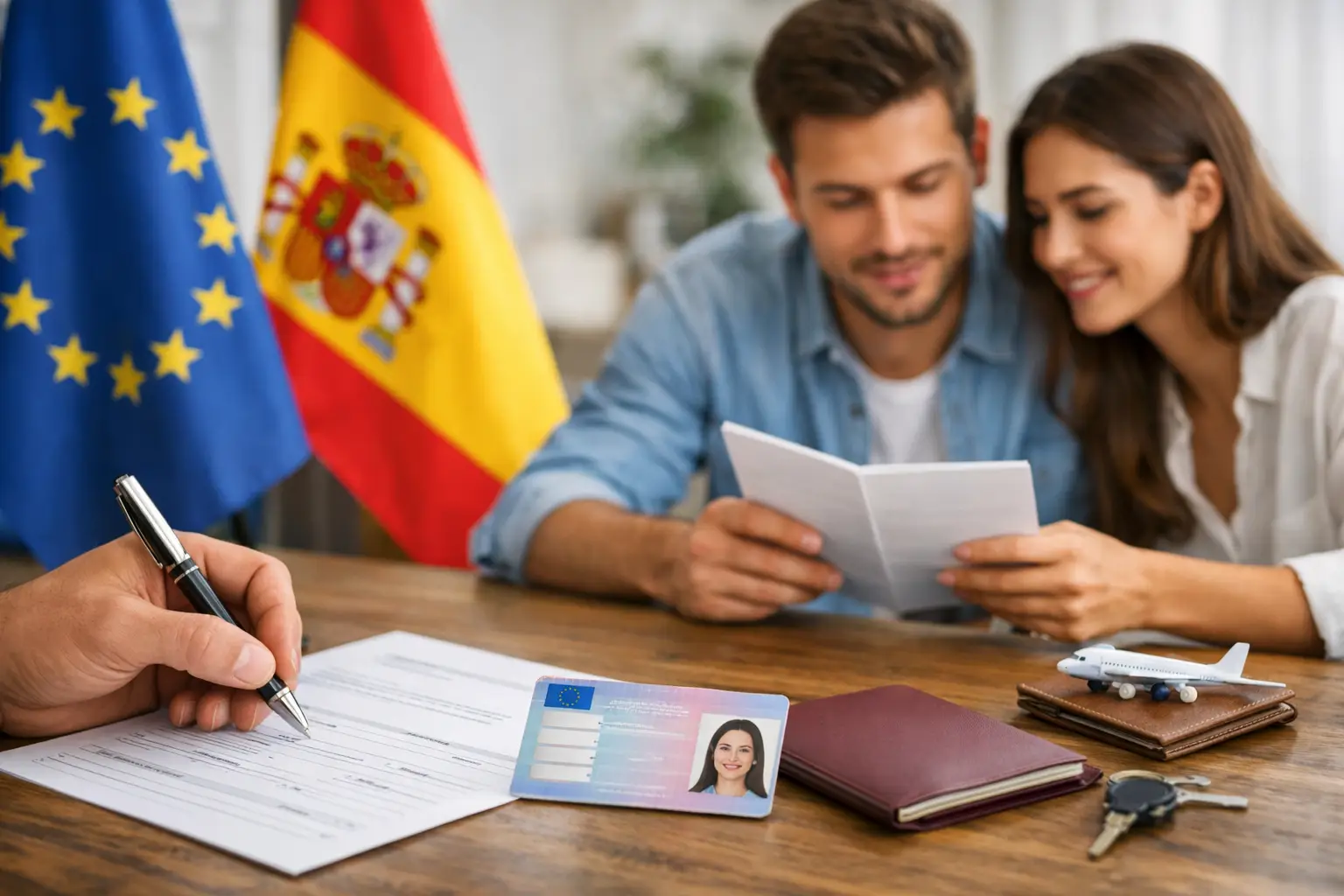
If you are preparing an eu family card Spain application, the first thing to verify is whether your case actually fits the residence regime for relatives of an EU citizen. That sounds obvious, but many delays start there. Families often gather documents for the wrong procedure, especially when the sponsor is Spanish, when the relationship was formed outside Spain, or when the non-EU relative is already in the country under another status.
In Spain, this process is commonly associated with the tarjeta de residencia de familiar de ciudadano de la Unión, often referred to in practice as the EU family card or tarjeta comunitaria. It gives qualifying non-EU relatives the right to reside in Spain with the EU citizen family member, and in many cases to work. The legal basis matters, but the practical issue is simpler – the immigration office will want clear proof of family relationship, the EU citizen’s status in Spain, and evidence that the legal requirements are met on the date of filing.
Who can file an EU family card Spain application
Not every family relationship is treated the same way. Spouses and registered partners are usually the most straightforward category, provided the marriage or partnership is legally valid and properly documented. Direct descendants and ascendants may also qualify, but the analysis changes depending on age, dependency, and whether the sponsoring citizen is from another EU country or is Spanish.
This is where families often run into confusion. A non-EU spouse of an Italian, French, or German citizen living in Spain may follow one route, while the relative of a Spanish citizen may be examined under related but distinct residence rules. The label people use online is often the same, but the legal path is not always identical. That distinction affects what evidence should be submitted and which office should review the file.
Another point that deserves attention is dependency. Parents, adult children, and some extended family members are not approved simply because they are related. The administration usually expects evidence that the family member depended financially or lived as part of the household before the move, or that there are serious health or care reasons justifying residence in Spain.
Before filing: eligibility matters more than speed
A rushed filing can create avoidable problems. For that reason, the strongest applications usually begin with a legal review of three points: the sponsor’s nationality and registration in Spain, the family link, and the non-EU relative’s current immigration situation.
The EU citizen sponsor generally must be residing in Spain and able to show that residence properly. Depending on the case, that may involve the EU registration certificate, proof of employment, self-employment, sufficient resources, health coverage, or padrón registration. If the sponsor cannot document lawful and effective residence in Spain, the family member’s application may be questioned even if the relationship itself is clear.
The non-EU relative’s position also matters. Some applicants are already in Spain and can file from within the country. Others are abroad and need to coordinate entry, visa issues, or consular documentation before the residence card stage becomes viable. There is no universal filing sequence that fits every family.
Documents usually required
An eu family card Spain application stands or falls on document quality. Immigration offices do not just want papers – they want papers that are current, consistent, translated where necessary, and legalized or apostilled if issued abroad.
Most cases involve the passport of the non-EU family member, identification of the EU citizen, proof of residence in Spain, and civil status documents proving the family relationship. Marriage certificates, birth certificates, or registered partnership certificates must usually be recent enough to satisfy the office handling the file. If they come from outside Spain, sworn translations into Spanish are commonly required unless the document is already issued in an accepted multilingual format.
In many cases, the file also needs proof that the EU citizen meets residence conditions in Spain. For employees, that may include an employment contract, recent payroll records, or Social Security registration. For self-employed individuals, tax and Social Security documentation may be needed. If the case relies on sufficient financial means instead of work activity, the office may look closely at bank records, savings, recurring income, and private or public health insurance.
Dependency cases require even more care. Sending a simple affidavit from the family is rarely enough. The administration may expect bank transfer records, evidence of prior cohabitation, medical reports, or a documented pattern of support over time.
How the application is filed in Spain
The filing stage depends on the province and on how the appointment system is functioning at that time. In general, the application is presented before the relevant immigration office in Spain, often through an in-person appointment or by electronic filing through an authorized representative.
That last point is more important than many applicants realize. Electronic filing through legal representation can reduce procedural friction, especially when appointments are scarce or when the case requires a carefully organized submission. It also makes it easier to track notices and respond to requests for additional documents within the deadline.
After filing, the administration may issue a request for further evidence if something is missing or unclear. This is common in real cases and does not automatically mean the matter is headed for refusal. What matters is whether the response directly addresses the concern raised, with legally coherent evidence rather than more paperwork that does not answer the actual issue.
Once approved, the next stage is usually the TIE card process, including fingerprinting and collection of the physical residence card. Approval of residence and issuance of the plastic card are related, but they are not the same administrative step.
Common problems in an EU family card Spain application
One recurring issue is assuming that a marriage certificate alone proves everything. It proves the marriage, but it does not prove that the sponsoring citizen is exercising qualifying residence rights in Spain. Another common problem is relying on outdated foreign documents or submitting certificates without apostille or sworn translation.
Unregistered relationships create a different challenge. Spain may recognize some stable partnerships, but not every relationship can be documented in a way that satisfies the immigration office. If the couple is not married and not formally registered, the burden of proof can become much heavier.
There are also cases involving prior immigration history in Spain. A person may have entered under a student status, a visa waiver, or another residence category. That does not always prevent filing, but it can affect strategy. The right approach depends on timing, the person’s current legal position, and whether there are any prior refusals or procedural complications on record.
Timing, work rights, and practical expectations
Families understandably want a clear calendar. Spanish immigration does not always provide one. Processing can vary by office, workload, and whether the file is complete from the start. What you can control is the quality of the submission and the speed of any response to official notices.
Work rights are another area where applicants need precision. Many people ask whether they can begin working immediately after filing. The answer depends on the exact procedural stage, the legal basis of the application, and what documentation has been issued. This is not an area for assumptions, especially for employers who need to verify authorization correctly.
For that reason, families should treat the application as both an immigration file and a status-planning exercise. Housing, school enrollment, employment start dates, and travel plans may all be affected by the administrative sequence.
Why legal analysis matters in family residence cases
Family-based immigration sounds personal, but in Spain it is also highly technical. Two couples with nearly identical stories can face different outcomes because one submitted the wrong residence route, used incomplete foreign documents, or failed to demonstrate the sponsor’s status properly.
That is where legal support changes the process. A well-prepared case is not just a stack of forms. It is a documented legal position built around the correct residence regime, the right evidence, and a filing strategy that anticipates questions before the immigration office raises them. For families dealing with mixed nationalities, prior immigration records, dependency issues, or Spanish citizen sponsorship, that analysis is especially valuable.
Lexmovea assists clients across Spain with residence procedures for relatives of EU and Spanish citizens, including document review, filing strategy, legal representation, and responses to immigration requirements. When the case is handled correctly from the beginning, families are in a far better position to move forward with confidence.
If your family is planning this application, the most useful next step is not guessing which online checklist applies to you. It is confirming which legal route fits your exact relationship, nationality mix, and status in Spain before a preventable mistake becomes part of the record.

Francisco Campos Notario, Lawyer ICAS 15702 and specialist in Immigration Law, offers updated content in Lexmovea. Find valuable information about immigration, residency and nationality procedures. For personalized consultations, contact us or visit our offices in Madrid and Seville.