
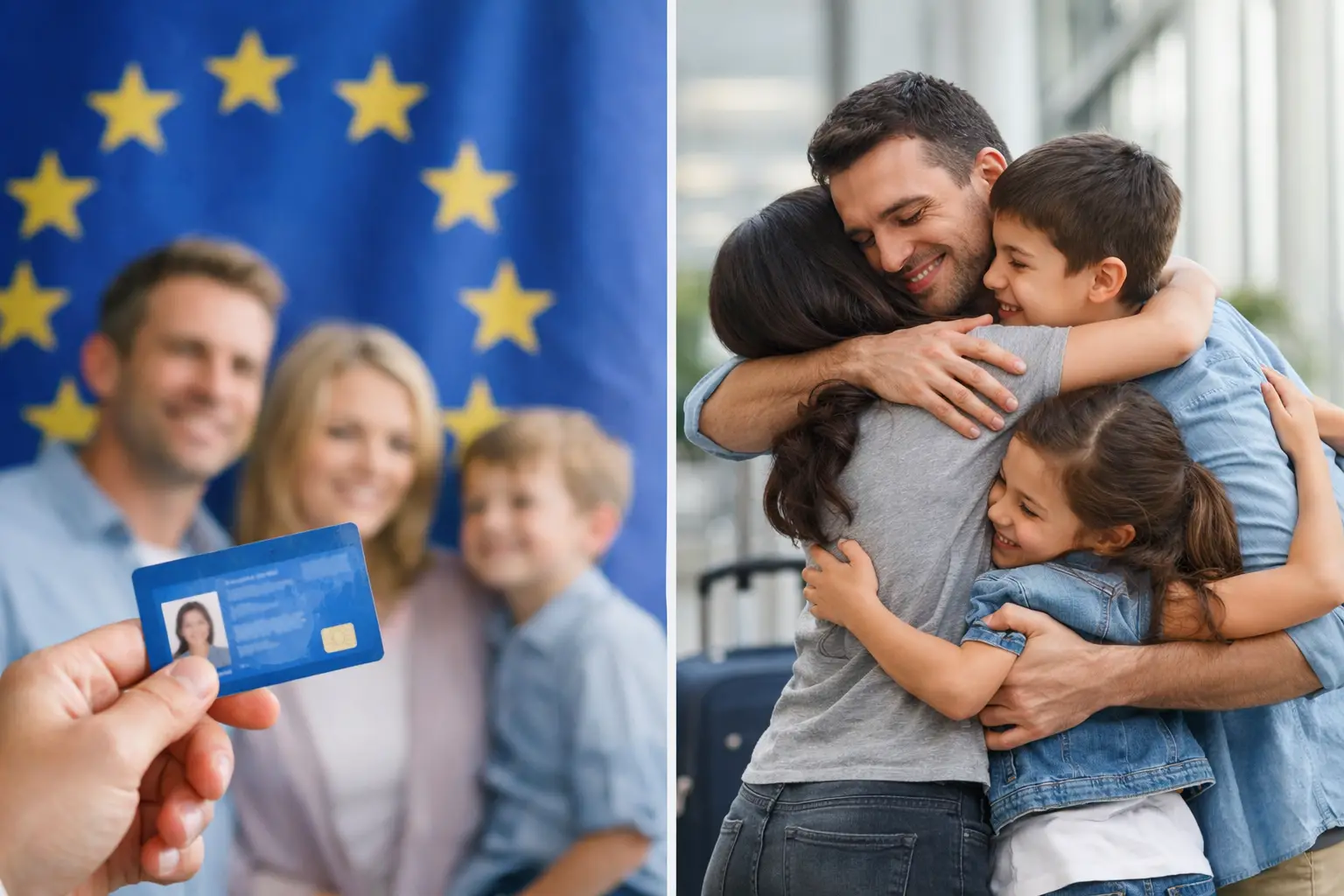
When a family is planning a move to Spain, the choice between an EU family card versus family reunification is not a minor paperwork detail. It shapes who can apply, where the application is filed, whether the relative can work, and how quickly the family can stabilize their status in Spain. Many applicants use the terms interchangeably, but in Spanish immigration law they are different procedures with different legal foundations.
This distinction matters most for mixed-nationality families. If your spouse is Spanish, French, Italian, German, or another EU citizen living in Spain, the route may be very different from the one used by a non-EU resident who wants to bring a spouse or children later. Choosing the wrong path can create avoidable delays, requests for further documents, or a filing that simply does not fit the case.
EU family card versus family reunification in Spain
In practical terms, the EU family card – commonly referred to as the tarjeta de familiar de ciudadano de la Union – is designed for certain non-EU relatives of an EU, EEA, or Swiss citizen who is residing in Spain and exercising treaty rights or otherwise meeting the applicable conditions. The legal logic is that the family member derives rights from the EU citizen.
Family reunification, by contrast, usually refers to the general immigration regime for non-EU nationals who already hold legal residence in Spain and want to bring qualifying relatives. Here, the resident sponsor is not relying on EU free movement rules. Instead, the case is assessed under Spain’s ordinary immigration framework, with its own residence period requirements, housing standards, proof of means, and consular processing in many situations.
That is the first major dividing line. The question is not only who the family member is. The question is also who the sponsor is.
Who qualifies under each route
The EU family card is often available when the sponsor is a Spanish citizen or another EU citizen living in Spain, and the applicant is a close non-EU relative. Most commonly, this includes spouses, registered partners, children under the relevant age limits, dependent ascendants, and in some cases other dependent family members if the dependency or household relationship can be documented properly.
Family reunification under the general regime is used when the sponsor is a non-EU national already residing legally in Spain. That person may want to bring a spouse, registered partner, minor children, certain adult disabled children, or dependent parents if the legal requirements are met. The eligibility criteria are narrower in some areas and stricter in others, especially when it comes to proving sufficient residence in Spain before starting the process.
A common point of confusion appears when the sponsor is a Spanish citizen. Many people assume this automatically means family reunification. In Spain, that is often not the correct route. For many relatives of Spanish citizens, the family member residence path linked to EU or Spanish-citizen status is the proper framework, not the general reunification procedure.
The biggest procedural difference
If you compare EU family card versus family reunification from a procedural angle, the most important issue is often where and when the application is made.
The EU family card is frequently processed from within Spain when the qualifying relative is already in the country under lawful conditions and can submit the residence application before the Immigration Office. That can make the route more workable for families who are already together in Spain and need to regularize the non-EU relative’s status correctly.
Family reunification typically starts with the sponsor in Spain obtaining authorization to reunify the family member. After approval, the relative abroad usually applies for the corresponding visa at the Spanish consulate in their country of residence, then enters Spain and completes the next registration steps. That structure makes reunification more sequential and, in many cases, less flexible.
This is one reason the correct classification matters from the start. Two families may have similar personal circumstances but completely different filing strategies because one sponsor is an EU citizen and the other is a third-country national.
Residence requirements for the sponsor
Under the general family reunification route, the sponsor usually must first complete a minimum period of legal residence in Spain and hold a renewed residence authorization before sponsoring certain relatives. This is a core requirement and often catches families by surprise. Someone who has only recently moved to Spain on a temporary permit may not yet be eligible to start the process.
The EU family card framework usually does not work that way. The focus is less on a prior period of residence by the sponsor and more on the existence of the qualifying family relationship, the sponsor’s status as an EU citizen or equivalent beneficiary, and proof that the sponsor is residing in Spain under the applicable conditions.
That difference can be decisive for couples who want to relocate together rather than live apart while one person first accumulates time in Spain.
Financial means, housing, and supporting documents
Both routes involve documentation, but not the same type of documentation or the same legal emphasis.
For family reunification, the Spanish authorities generally examine whether the sponsor has sufficient economic means and adequate housing to receive the family member. The housing report from the regional or local authority can be a central piece of the file. Income thresholds, household size, and documentary consistency matter a great deal.
For the EU family card, the analysis is tied more closely to the sponsor’s right of residence in Spain and the family link. Depending on the sponsor’s profile, this may involve employment documents, self-employment registration, proof of public or private health coverage, and evidence of sufficient resources. Family documents must also be prepared carefully, especially marriage certificates, birth certificates, and documents proving dependency where relevant.
In both procedures, foreign civil documents often need legalization or apostille and certified translation into Spanish. That administrative layer is frequently underestimated, and it is one of the reasons technically valid cases can still run into procedural friction.
Work rights and practical impact on family life
For many families, the real question is not legal theory but daily life. Can the spouse work? Can the family settle quickly? Can children enroll in school without uncertainty hanging over the household?
The EU family card generally provides a more favorable position regarding work authorization for the non-EU relative once the residence right is recognized. That is one reason it is often the preferred route when it is legally available.
Family reunification can also lead to residence rights for relatives, and in many cases work authorization is available or becomes available under the permit granted, but the route is more structured around the sponsor’s immigration status and the category of family member. The exact effects depend on the permit issued and the stage of the process.
This is where broad internet advice becomes risky. People often hear that one route is faster or easier. In reality, the better route is the one that actually matches the legal facts of the family.
Common mistakes when comparing the two
The first mistake is assuming that marriage alone determines the process. It does not. A spouse of a Spanish citizen, a spouse of an Italian citizen, and a spouse of a non-EU resident in Spain may each fall into a different legal framework.
The second mistake is overlooking dependency rules for parents or adult children. Dependency is not a casual concept in Spanish immigration filings. It must usually be documented with financial transfers, proof of economic need, cohabitation history, medical evidence when relevant, and a coherent factual record.
The third mistake is treating the EU family card and family reunification as equally interchangeable fallback options. In some cases, only one route is legally appropriate. Filing under the wrong regime can lead to refusal even if the family relationship itself is genuine.
Which route is better?
There is no universal winner in the EU family card versus family reunification question. The EU family card is often more favorable when the sponsor is a Spanish or other EU citizen because the legal structure tends to be more accommodating for preserving family unity. But that does not help if the sponsor is actually a non-EU resident subject to the general regime.
Family reunification remains the correct and necessary route for many families in Spain, particularly where the sponsor has already built legal residence in the country and wants to bring close relatives under the ordinary immigration rules. A strong case depends on timing, sponsor status, family relationship, and document quality.
The practical way to approach this is to identify the sponsor’s nationality and residence status first, then map the family relationship, then review where the applicant is located, and only after that decide the filing strategy. In a technical area like Spanish immigration law, the name of the procedure is never just a label. It determines the entire path forward.
For families planning their next step in Spain, clarity at the beginning is often what protects the family unit later.

Francisco Campos Notario, Lawyer ICAS 15702 and specialist in Immigration Law, offers updated content in Lexmovea. Find valuable information about immigration, residency and nationality procedures. For personalized consultations, contact us or visit our offices in Madrid and Seville.