

If you are searching for the Spain digital nomad visa, the digital nomad residence permit, or simply how to live in Spain while working remotely, you are probably asking the same practical questions: am I eligible, how much income do I need, can I apply from inside Spain or do I need a consulate, how long does it take, and what happens with tax and social security. This page answers them in plain English, with the verified 2026 figures, and explains how Lexmovea can support your application from eligibility through to your TIE card.
The Digital Nomad Visa was created by Spain’s Startup Law (Ley 28/2022) and is officially the international teleworking authorization. It lets non-EU remote workers and freelancers live in Spain legally while continuing to work for foreign companies or clients. Applications are handled by the Unidad de Grandes Empresas (UGE), the dedicated government unit, which is one reason this route is usually faster than standard immigration procedures.
Who it’s for
The visa is aimed at non-EU citizens who can prove they work remotely using digital tools. The typical profiles:
- Employees of a foreign company authorized to work remotely from Spain.
- Freelancers or contractors working for one or several foreign clients.
- Founders or business owners who provide services remotely and can document the activity and income.
If your income is passive rather than from active remote work — a pension, savings, dividends, or rentals — this is not your route; the non-lucrative visa is. We compare the two below.
Income requirements (2026 figures)

The income threshold is the question most people come for. Unlike the non-lucrative visa, which uses the IPREM, the digital nomad visa is tied to the minimum wage (SMI). For 2026 the SMI is €1,221 per month in 14 payments (Royal Decree 126/2026), and the UGE works from the annual figure. The thresholds, on gross (pre-tax) income, are:
- Main applicant: 200% of the SMI — about €2,850 per month (€34,188 per year).
- First family member: +75% of the SMI — about €1,068 per month.
- Each additional family member: +25% of the SMI — about €356 per month.
So a couple needs roughly €3,900 per month, and a couple with one child around €4,270 per month. Because the threshold tracks the minimum wage, it rises whenever the SMI does — which matters again at renewal. The UGE looks at gross income, not take-home pay, so a payslip showing €3,200 gross qualifies even if the net is lower.
Two practical points that decide files in 2026: if you are paid in dollars, pounds, or another currency, the UGE converts at the exchange rate when it reviews, so leave a 10–15% buffer above the minimum; and bank statements should be physically stamped by your bank, since plain PDF downloads are often rejected. You can combine income with savings, but your own remote-work income should carry the clear majority of the requirement.
The other requirements
Beyond the income, the UGE decides these cases on a checklist where the evidence — not just the fact — is what matters:
- Non-EU nationality and work that can be done remotely using electronic means.
- An established relationship with the foreign company or client — at least three months before filing — and, for employees, a company that has been operating for at least one year.
- Qualification or experience: a relevant degree from a recognised institution, or at least three years’ experience in the field.
- The 20% rule: no more than 20% of your professional activity may come from Spanish companies or clients. Renewals now check this against your actual records.
- Clean criminal record covering the last five years, apostilled or legalised and sworn-translated.
- Private health insurance with full coverage in Spain, no co-payments and no waiting periods, from an insurer authorised in Spain. Non-compliant insurance is one of the top refusal reasons.
- Social security cover: proof you remain covered while in Spain — a Certificate of Coverage where a totalisation agreement applies, or registration and contributions in Spain otherwise. A mismatch here is a frequent cause of delay.
A note on the current climate: the UGE was restructured in early 2026 with a senior review team and a fraud crackdown on fake contracts and unregistered social security. The rules did not change, but scrutiny tightened — which makes a clean, consistent file matter more than ever.
Two ways to apply: from Spain or from a consulate
This is the decision that shapes your whole experience, because the two routes give very different permits:
- From within Spain (the recommended route): if you enter legally — for most nationalities, visa-free as a tourist — you apply to the UGE within your first 90 days, and approval grants a residence permit valid for up to three years. Processing is typically around 20 working days. File at least 30 days before your tourist stay expires.
- From a consulate abroad: you apply at the Spanish consulate for your country, and approval gives a one-year visa to enter Spain, which you then swap for a residence permit (renewable in two-year periods from within Spain). Consular timelines vary by location and appointment availability.
The documentation is largely the same; the timelines, the initial permit length, and the post-approval steps differ. For most people already able to enter Spain visa-free, the in-Spain route is simpler and gives the longer permit straight away.
One important correction to a common myth: you cannot switch into the digital nomad visa from within Spain if you hold a non-lucrative visa or are on a tourist entry intending to convert from another non-work status. As the UGE confirmed in 2026, those profiles must apply at a consulate abroad. The in-Spain route is for those entering legally and applying directly under the telework framework, not for converting an existing non-work permit.
Documents you’ll need

The core document set is the same for both routes; what separates an approval from a request for more documents is the quality and consistency of the evidence:
- Valid passport with copies, name spelling consistent across every document.
- Application form: the national visa form (consulate) or the UGE telework form (in-Spain), plus the fee.
- Proof of income above the threshold: employment contract and payslips (employees), or client contracts and invoices (freelancers), supported by bank-stamped statements over several months.
- Proof of the professional relationship: at least three months with the company or clients, and proof the company has operated for at least a year.
- Remote-work authorization letter (employees) or client contracts (freelancers) — see the structure below.
- Qualification evidence: degree or three years’ experience.
- Private health insurance meeting the standard above.
- Criminal record certificate (last five years), apostilled or legalised and sworn-translated.
- Social security documentation matching your profile.
The remote-work letter (what makes or breaks a file)
If one document repeatedly decides an application, it is the remote-work authorization letter (employees) or the client-contract package (freelancers). To be decision-ready for the officer, it should state your identity and role, explicit permission to work remotely from Spain using electronic tools, the relationship start date confirming the three-month minimum, your compensation and its periodicity, confirmation the relationship is ongoing through the residence period, and the company’s legal details and confirmation it has operated for at least a year. If it is not in Spanish, add a sworn translation.
Apostille and sworn translation
Foreign documents generally need apostille or legalisation and a sworn translation. The usual failure points are documents from the wrong authority, a missing apostille, translations that are not sworn, and certificates that expire before filing. US criminal records in particular can take weeks, so plan formalities first and work backwards from your target filing date.
Bringing your family
Your spouse or partner and your dependent children — and in some cases dependent parents — can be included, either with the main application or later. You prove the income thresholds above plus the relationship, with civil-status documents (marriage and birth certificates) apostilled or legalised and translated where required; for parents or adult children, you also show dependency. A strong advantage of this route: dependents of working age receive full Spanish working rights, so they can work locally, be self-employed, or continue their own remote work.
Validity, renewal, and the path to permanent residence
The in-Spain route grants up to three years initially; the consular visa grants one year, then converts to a renewable residence permit. Renewals require that you still meet the conditions — income, ongoing remote work, insurance, and the 20% Spanish-income cap. After five years of continuous legal residence (with no more than ten months spent outside Spain) you can apply for long-term residence, and the time counts toward Spanish nationality by residence where you are eligible. Temporary trips abroad are fine, but long absences affect renewals and the long-term clock.
Digital nomad visa vs non-lucrative visa
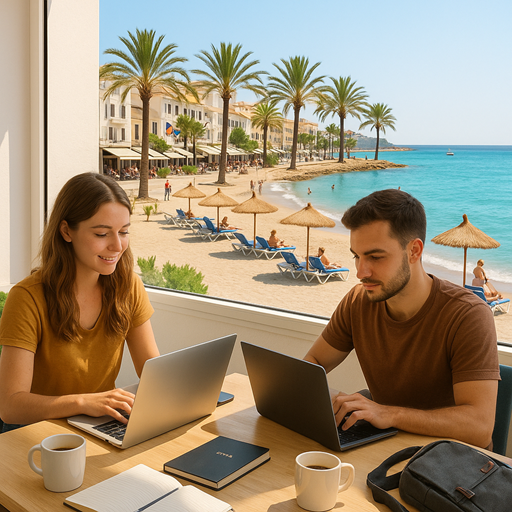
This is the most common comparison, and the right choice comes down to one thing: do you need to work? If you earn your income actively through remote work, the digital nomad visa is built for you. If you live on passive income and do not need to work, the non-lucrative visa is the simpler route.
| Question | Digital Nomad Visa | Non-Lucrative Visa |
|---|---|---|
| Can you work? | Yes — remote work for foreign (and limited Spanish) clients/employers | No work in Spain; passive income only |
| Income basis | Active: salary or professional income from remote work | Passive: pensions, savings, rentals, dividends |
| 2026 income guide | €2,850/month (200% SMI) + €1,068 first dependent | €28,800/year (400% IPREM) + €7,200 per dependent |
| Where you apply | Consulate or from within Spain (if entering legally) | Consulate only for the initial application |
| Initial length | Up to 3 years (in-Spain route) | 1 year, then 2+2 |
| Best for | Remote employees and freelancers | Retirees, financially independent applicants |
For full detail on the passive-income route, see our non-lucrative visa page. And note that Spain’s Golden Visa (residence by real-estate investment) was abolished in 2025, so it is no longer an alternative for those weighing these options.
Tax: the practical reality
Tax is the most misunderstood part of this visa, and the headline “24% flat rate” hides important conditions. The essentials, with a strong recommendation to get tailored advice before you rely on any of it:
- Tax residency: spending around 183 days a year in Spain generally makes you a Spanish tax resident, though your center of economic interests and family ties also count. If you plan to live mostly in Spain, plan the tax position before you arrive, not after.
- The Beckham Law: the special expat regime offers a flat 24% on Spanish-source employment income up to €600,000, instead of progressive rates that reach up to 47%. But it is a separate application from the visa, must be filed within six months of social security registration (a window that cannot be extended), and in practice is available to employed nomads, not self-employed autónomos.
- Double taxation: treaties between Spain and your home country, and totalisation agreements for social security, can change the outcome significantly depending on nationality and income type.
For mixed-income profiles (salary plus dividends or rentals), the regime with the lowest headline rate is not always the best overall, which is why a short tax review pays for itself.
After approval
Once approved, the sequence is: if you used the consular route, enter Spain within the visa’s validity; book your biometrics appointment (toma de huellas) and apply for the TIE within 30 days of the authorization; align your social security cover or registration with your profile; and keep your income, remote-work relationship, and insurance current through the residence period to support renewals. Appointment availability for biometrics can be a bottleneck in some cities, so book early.
Common reasons for refusal
Most refusals come from an unclear or inconsistent file rather than genuine ineligibility. The recurring triggers, all preventable:
- A vague employer letter missing explicit remote-work permission, the start date, continuity, or clear pay terms.
- Income proof that doesn’t read as stable: irregular amounts without explanation, missing contracts or invoices, too few months, or unstamped statements.
- The three-month rule: not being able to show the relationship started at least 90 days before filing.
- Non-compliant insurance: co-payments, exclusions, waiting periods, or a provider not authorised in Spain.
- Criminal-record formalities: wrong scope, expired certificate, or missing apostille or sworn translation.
- Social security mismatch between how you say you’ll be covered and your documents.
How we help
Our support is built around two things: speed and refusal prevention. We confirm the right route (in-Spain vs consulate) and your profile fit (employee, freelancer, or founder), calculate the exact threshold for your household and map the strongest evidence, structure the remote-work letter and document pack to the standard the UGE expects, coordinate apostille and translation timing, and support you through submission, any requests for more documents, and the post-approval TIE. With scrutiny tightening in 2026, a clean file is the difference between a fast approval and a refusal.
For help with your Spain digital nomad visa, contact Lexmovea. We assess your eligibility, build the file, and guide you step by step — in English throughout.
Frequently asked questions
How much income do I need for the Spain digital nomad visa in 2026?
€2,850 per month gross (200% of the 2026 SMI) for the main applicant, plus about €1,068 for the first family member and €356 for each additional one. A couple needs roughly €3,900 and a couple with one child around €4,270. Leave a 10–15% buffer if your income is in another currency.
Can I apply from inside Spain?
Yes, if you enter legally — for most nationalities, visa-free as a tourist — and apply to the UGE within your first 90 days. This route grants a residence permit of up to three years and is usually faster. You cannot, however, switch into it from a non-lucrative visa; that requires applying at a consulate abroad.
How long does it take?
The in-Spain UGE route is often resolved in around 20 working days; consular timelines vary by location and appointment availability. In both cases, document preparation — background checks, apostilles, translations — usually takes longer than the decision itself.
Can I work for Spanish clients?
Up to 20% of your total professional activity. Renewals now check this against your actual income records, and going well over the cap makes refusal likely.
Can my family come, and can they work?
Yes. Your spouse or partner and dependent children can be included if you meet the higher income thresholds and provide legalised, translated relationship documents. Dependents of working age receive full Spanish working rights.
How are taxes handled?
Spending around 183 days in Spain generally makes you a tax resident. Employed nomads may opt into the Beckham regime (a flat 24% on Spanish employment income up to €600,000), filed separately within six months of social security registration; it is generally not available to self-employed autónomos. Tailored tax advice is strongly recommended.
Do I need health insurance?
Yes — private insurance with full coverage in Spain, no co-payments and no waiting periods, from an insurer authorised in Spain. Non-compliant insurance is one of the most common refusal reasons.
What if I don’t qualify for the digital nomad visa?
Depending on your profile, alternatives include the non-lucrative visa (for passive income, no work), highly qualified worker permits, student routes, or other work and self-employment authorizations. We can map the best fit in a consultation.