
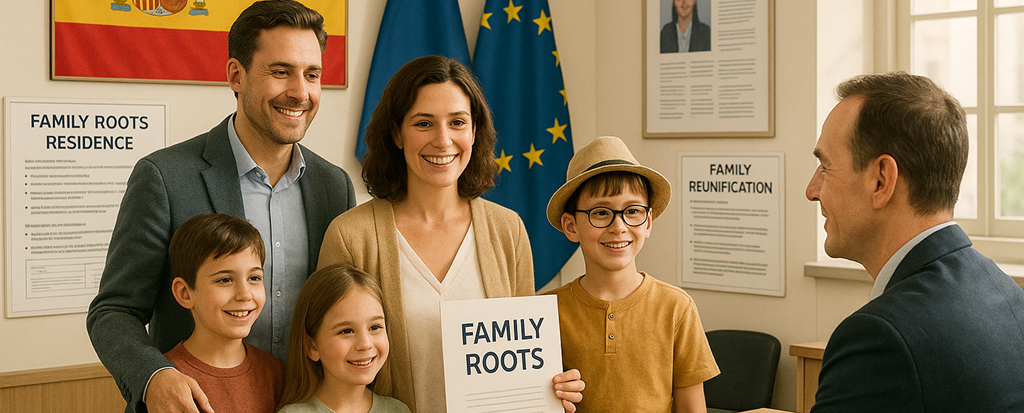
Arraigo familiar (family arraigo) is a Spanish residence authorization based on close family ties — but the new Immigration Regulation, Real Decreto 1155/2024 (in force since 20 May 2025), changed who it is for in a way that catches most people out. This page explains, in plain English, what arraigo familiar now is, who actually qualifies, the documents and the process — and, just as importantly, where to go instead if your family member is Spanish, because that is now a different (and more generous) route.
The most important point: who arraigo familiar is for now
If you have read older guides saying arraigo familiar is for the spouse, parent, or child of a Spanish citizen, that is no longer correct. Since 20 May 2025, arraigo familiar is reserved for family members of EU, EEA, or Swiss citizens — not Spanish nationals — in two specific situations. Family of Spanish citizens now have their own, separate authorization, which we point you to below.
So before anything else, find your situation here:
- Your family member is Spanish (you are the parent of a Spanish child, or the spouse, partner, parent, or child of a Spanish national): your route is the residence authorization for family members of Spanish citizens (the EX-24), which gives a five-year card and is more favourable. This is not arraigo familiar anymore.
- Your family member is an EU/EEA/Swiss citizen (not Spanish): depending on the case, you may use arraigo familiar (the two scenarios below) or the EU family member card. This page is for you.
- Your family member is a non-EU legal resident: that is family reunification or arraigo social territory, not arraigo familiar.
Getting this right at the start is the difference between a strong application and months lost on the wrong route.
What arraigo familiar gives you
Arraigo familiar is a residence authorization for exceptional circumstances with some real advantages:
- Five years. It is granted for five years from the start — unusually long for an arraigo figure.
- Work included. It allows you to work, employed or self-employed, with no separate step.
- No minimum prior residence. Unlike arraigo social or sociolaboral, it does not require you to have spent two years in Spain first.
- Renewable toward long-term residence while the qualifying situation continues.
Who qualifies: the two scenarios
The regulation limits arraigo familiar to two cases, both involving an EU/EEA/Swiss citizen:
1. Parent or legal guardian of a minor who is an EU/EEA/Swiss citizen
You are the parent or guardian of a minor who is a national of another EU/EEA/Swiss state (for example, a French, German, or Italian child) living in Spain. You must reside in Spain, have the child in your care, and either live with the child or show you meet your parental obligations (maintenance payments, involvement in the child’s care or education, or a custody ruling or regulating agreement that proves it). The child does not need to be Spanish — it is specifically for minors who are citizens of another EU/EEA/Swiss country.
2. Carer of an EU/EEA/Swiss citizen with a disability
This is a scenario introduced by the new regulation. You provide support to an EU/EEA/Swiss citizen with a disability — child or adult — to help them exercise their legal capacity, where you are their relative, have them in your care, and live with them. Two important points: the person must have an official recognition of disability or dependency from the competent authority, and the authorization can be granted to only one qualifying carer — two people cannot both claim to support the same person.
The general conditions
On top of fitting one of the two scenarios, you must be a non-EU/EEA/Swiss national, have no criminal record in Spain or in the countries where you have lived in the last five years, not be subject to an entry ban or a non-return commitment, and pay the fee.
If your family member is Spanish: the route you actually need

Because so many people arrive here looking for the old route, this is worth stating clearly. If you are the parent of a Spanish minor, or the spouse, registered partner, parent, or child of a Spanish national, the regulation now channels you into a dedicated authorization: the residence authorization for family members of Spanish citizens. It is generally more favourable than the old arraigo familiar — a five-year card, full work rights, and a faster resolution — and it is the correct legal basis for your case. Filing arraigo familiar instead would simply be the wrong route.
If your relative is an EU/EEA/Swiss citizen but your situation does not fit the two arraigo scenarios above — for instance, you are a spouse or partner of an EU national — the EU family member card is usually the route. We confirm the correct basis before filing anything.
Documents
The exact pack depends on which of the two scenarios applies, but the core is:
- Form EX-10, completed and signed, in duplicate.
- Full copy of a valid passport.
- Criminal record certificate from the countries where you lived in the five years before entering Spain — apostilled or legalised and sworn-translated where needed.
- Proof of the family link and the relative’s EU/EEA/Swiss nationality: the minor’s birth certificate, or the disabled person’s documentation, plus their national ID.
- Scenario-specific proof: joint census registration or a cohabitation certificate where you live together; or, if you do not live with the child, evidence you meet your parental obligations (maintenance, a custody ruling). For the disability scenario, the official disability or dependency recognition and proof of the care you provide.
- Fee (model 790, code 052).
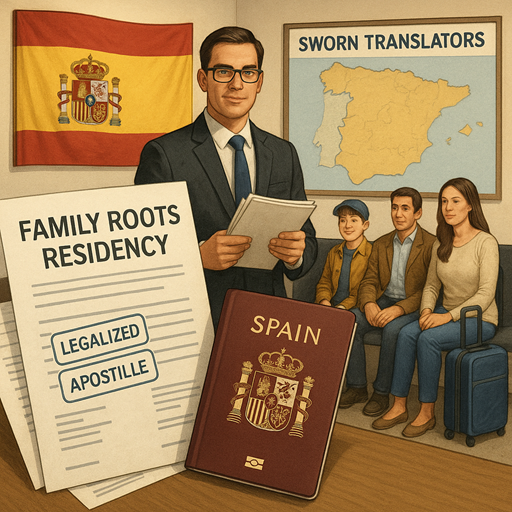
Foreign documents usually need apostille or legalisation and a sworn translation, and certificates have validity windows — preparing them correctly is one of the most common hidden failure points, so it is worth checking before you file.
How to apply, and how long it takes
You file at the Immigration Office (Extranjería) for your place of residence, either in person by appointment or online through the Mercurio platform with a digital certificate or an authorised representative. You keep the filing receipt — it is your proof the application is in process and lets you track its status.
The legal resolution deadline is three months from when the application enters the register; if there is no response in that time, it is generally understood as rejected by administrative silence, though in practice some offices take longer. The best way to avoid delay is a complete, coherent file and a quick, focused response to any request for more documents (subsanación).
If you are approved, you then book a police appointment for fingerprints and your TIE card (form EX-17, the corresponding fee, photos). If you are refused, you can file an administrative appeal within one month or a judicial appeal within two months — and given the strict deadlines, a refusal should be reviewed quickly.
Renewal and the longer term
The five-year card can be renewed while the qualifying situation continues, and it can lead toward long-term residence, which allows you to live and work in Spain on a stable, indefinite basis. Because your status depends on the underlying family situation, significant changes — the child reaching adulthood, a change in the care arrangement — can affect it, so it is worth planning the next step before the card expires rather than after.
How we help
The single biggest value here is route selection — confirming whether your case is genuinely arraigo familiar, the family-of-Spaniards authorization, the EU family card, or another arraigo, before you invest in the wrong file. From there, Lexmovea maps your scenario, builds the evidence pack (these are proof-driven cases, especially the care and custody situations), completes the form and fee correctly, files online or in person, handles any subsanación, and guides the post-approval TIE and later renewal. We work in English throughout.
If you’d like us to confirm your route and prepare your application, contact Lexmovea.
Frequently asked questions

Is arraigo familiar still for the family of Spanish citizens?
No. Since 20 May 2025, arraigo familiar is reserved for family members of EU/EEA/Swiss citizens in two specific scenarios. Family of Spanish nationals now use a dedicated authorization — the residence permit for family members of Spanish citizens — which is more favourable.
I’m the parent of a Spanish child. Which route is mine?
The residence authorization for family members of Spanish citizens (the EX-24), not arraigo familiar. It gives a five-year card with full work rights. Arraigo familiar would only apply if your child were a citizen of another EU/EEA/Swiss country rather than Spanish.
Who exactly can apply for arraigo familiar now?
Two groups: the parent or guardian of a minor who is an EU/EEA/Swiss (non-Spanish) citizen, living with the child or meeting parental obligations; and the sole carer of an EU/EEA/Swiss citizen with a recognised disability, living with and supporting them.
How long does it last, and can I work?
It is granted for five years and allows you to work, employed or self-employed, with no separate step. It is renewable toward long-term residence while the qualifying situation continues.
Do I need to have lived in Spain for a minimum time?
No. Unlike arraigo social or sociolaboral, arraigo familiar does not require any minimum prior residence in Spain. What matters is the qualifying family situation.
What documents do I need?
The EX-10 form, passport, criminal record certificate, proof of the family link and the relative’s EU/EEA/Swiss nationality, and scenario-specific proof (cohabitation or parental obligations for the minor case; official disability recognition and proof of care for the disability case). Foreign documents usually need apostille or legalisation and a sworn translation.
How long does the process take?
The legal deadline is three months from filing, with silence generally meaning rejection, though some offices take longer. You file in person by appointment or online through Mercurio with a digital certificate.
Can two people get arraigo familiar for caring for the same person?
No. In the disability-carer scenario, the authorization can be granted to only one qualifying carer of the same EU/EEA/Swiss citizen.
What if I’m refused?
You can file an administrative appeal within one month of notification, or a judicial appeal within two months. Because the deadlines are strict, a refusal should be assessed quickly — and sometimes the better answer is that a different route fits your facts.