
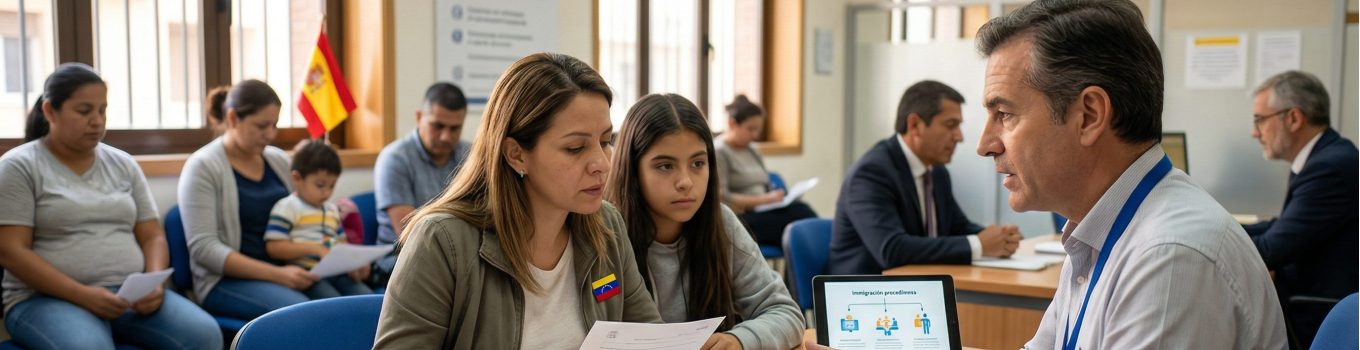
The Spanish Government has announced the termination, scheduled for June 2026, of the exceptional pathway that allowed for the expedited administrative regularization of Venezuelan citizens. This mechanism, operational since 2018, consisted of the nearly automatic granting of residence permits for humanitarian reasons following the denial of an application for international protection. At Lexmovea, as experts in Immigration Law, we analyze the legal implications of this regulatory change and the available legal alternatives.
Background of Fact and Law
Historically, faced with the impossibility of granting refugee status on a generalized basis, the Spanish Administration opted to apply this exceptional figure provided for in immigration regulations. This authorization granted the individual the right to legally reside and work in Spanish territory, being renewable and ultimately facilitating the computation of the legal period required to obtain Spanish citizenship. Official figures from the Ministry of the Interior reflect the magnitude of this measure, with the granting of approximately 240,000 authorizations to Venezuelan nationals since its inception, accounting for 99.4% of the total of these permits granted in Spain in 2025.
Motivations Behind the Change in Legal Criterion
The justification for this shift in immigration policy lies in a plurality of structural and cyclical factors:
- Change in the sociopolitical context: The shift in Venezuela’s political landscape following the recent events of January 3, 2026, which have opened a transitional period, undermines, in the eyes of the Administration, the generalized applicability of the humanitarian cause.
- Saturation of the international protection system: The sheer volume of applications has severely strained administrative capacity. The intensive use of this mechanism operated in practice as a regular channel for obtaining legal residency, generating bottlenecks and undue delays in asylum procedures in the strict sense.
- European homogenization: Spain seeks to align its policies with the standards of the European asylum system, correcting the statistical distortions caused by the massive granting of these permits.
Legal Consequences and Non-Retroactivity
It is imperative to underline, from a strictly legal and technical perspective, that this measure has no retroactive effect. Citizens who already hold a residence permit for humanitarian reasons will not have their status revoked, nor will they face deportation proceedings for this cause.
However, new applicants will lose this differentiated treatment and will see their files subjected to the rigor of the ordinary procedure. Authorizations for humanitarian reasons will once again be limited to their strict legal assumptions, such as sudden serious illnesses or exceptional situations that are duly and individually proven.
Transition to the Ordinary Regime and Extraordinary Regularization
Given the closure of this expedited pathway, access to residency must now be articulated through the ordinary regime provided for in Organic Law 4/2000 and its regulatory development, highlighting the different modalities of arraigo (social, labor, family, or training ties).
Likewise, the imminent Extraordinary Regularization Process, derived from the reform of the Immigration Regulations, takes on special relevance. This transitional instrument will allow the obtaining of a residence authorization for those foreign nationals who meet specific requirements, among which the following stand out:
- Proving their stay in Spain prior to January 1, 2026.
- Lacking a relevant criminal record.
- Having remained in the country for at least five months at the time of submitting the application.
Legal Recommendation
The end of the express pathway requires a change in legal strategy for Venezuelan citizens wishing to regularize their status in Spain. From the legal department at Lexmovea, we urge you not to delay the initiation of your procedures and to seek preventive advice to evaluate the suitability of your profile regarding the figures of ordinary arraigo or your inclusion in the imminent extraordinary regularization process.

Francisco Campos Notario, Lawyer ICAS 15702 and specialist in Immigration Law, offers updated content in Lexmovea. Find valuable information about immigration, residency and nationality procedures. For personalized consultations, contact us or visit our offices in Madrid and Seville.