
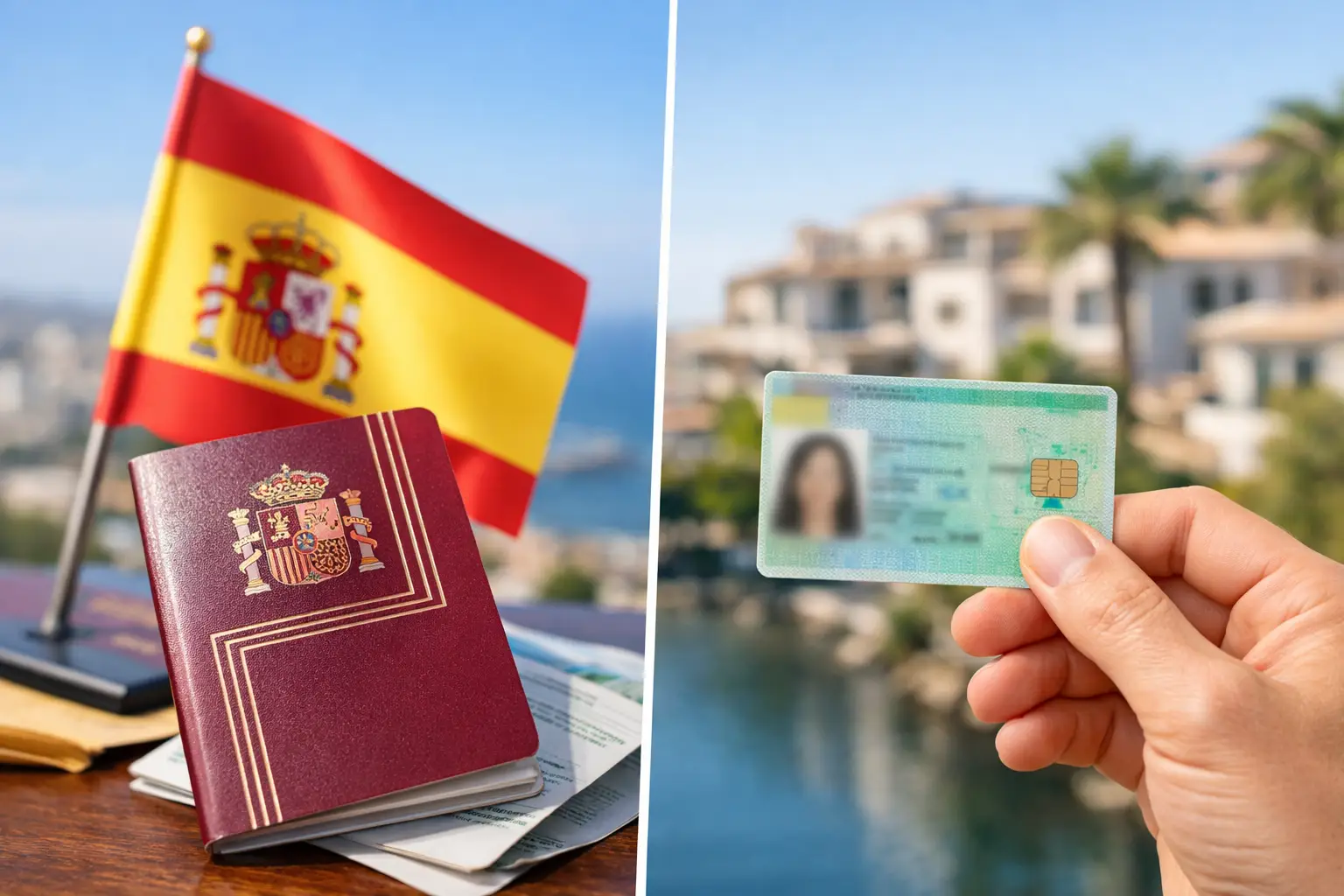
A residence card can feel permanent when your life, work, and family are already established in Spain. Legally, however, Spanish nationality versus permanent residency is not a choice between two versions of the same status. One preserves your foreign citizenship while securing a long-term right to live in Spain. The other makes you a Spanish citizen, with a Spanish passport and the full rights and responsibilities that citizenship carries.
The right path depends on more than how long you have lived in Spain. Your nationality, residence history, family circumstances, travel plans, and intentions outside Spain can all change the answer.
Spanish Nationality Versus Permanent Residency: The Core Difference
Permanent residency is an immigration status. For most non-EU nationals, it normally takes the form of a long-term residence authorization, commonly called residencia de larga duración. It gives the holder an indefinite right to reside and work in Spain, without the ordinary renewal cycle attached to temporary permits. You remain a national of your country of origin and continue to travel on that country’s passport.
Spanish nationality is civil status and citizenship. A person who acquires nationality by residence becomes Spanish, can obtain a Spanish DNI and passport, vote in national elections, and exercise EU free-movement rights as a Spanish and European Union citizen.
That distinction matters at the border, in an employment context, and when planning a future outside Spain. A long-term resident may have a stable life in Spain but does not have the same automatic right to settle or work in another EU country. A Spanish citizen does, subject to the registration rules of the destination country.
EU citizens follow a different route. After five years of legal residence in Spain, they may acquire a permanent right of residence under EU free-movement rules. Their registration documentation is not the same as a non-EU long-term residence card, but the practical question remains similar: permanent residence is not Spanish citizenship.
What Permanent Residency Gives You
For a non-EU resident, long-term residence is often a significant milestone. It generally allows you to live and work in Spain indefinitely, as an employee or self-employed professional, without needing to keep the original basis of residence that brought you to Spain. For example, a person who first arrived through a work authorization, family reunification, non-lucrative residence, or a digital nomad visa may eventually qualify if the legal requirements are met.
The standard route normally requires five years of legal and continuous residence immediately before the application. Continuity is not simply a matter of holding a valid TIE. Time spent outside Spain must be reviewed carefully, since excessive absences can interrupt the qualifying period or affect the status after it is granted.
Long-term residence is especially useful for someone who wants certainty in Spain without changing nationality. It can allow a resident to change jobs, build a business, or remain in Spain after a relationship or employment arrangement has changed, provided the relevant legal conditions are satisfied.
It also has limits. The physical card must be renewed periodically even though the underlying authorization is indefinite. More importantly, long-term residence can be lost after certain extended absences, including a continuous period of 12 months outside the European Union or six years outside Spain. The exact consequences depend on the type of authorization and the resident’s circumstances.
A Spanish long-term EU residence authorization may offer a structured route to seek residence in another participating EU state. It is not equivalent to the automatic free-movement rights enjoyed by an EU citizen. Another country can still require an application, documentation, and compliance with its domestic rules.
What Spanish Nationality Changes
Nationality removes the need to maintain an immigration authorization in Spain. There is no TIE renewal as a foreign resident, and residence restrictions based on employment, income, or the original visa category no longer apply.
The most visible benefit is the Spanish passport. For internationally mobile families, founders, and professionals, this can materially change travel and relocation options. Spanish citizens are also EU citizens, which creates a right to live, work, study, and establish a business in other EU and EEA countries, subject to local registration formalities.
Nationality can also matter for family planning. Children may acquire Spanish nationality by origin or have access to specific nationality procedures depending on where they are born, the parents’ nationalities, and the family’s residence history. These cases require a fact-specific civil registry review. A child born in Spain is not automatically Spanish in every situation.
Nationality does not eliminate every administrative obligation. Tax residence still depends primarily on facts such as where you spend your time and maintain your center of economic interests. A Spanish citizen living abroad may not be Spanish tax resident, while a foreign national with long-term residence in Spain may be. Immigration status and tax status should be assessed separately.
Eligibility and Timing Are Not the Same
The typical qualifying period for Spanish nationality by residence is 10 years of legal, continuous residence immediately before the application. However, Spain provides shorter periods in defined cases. Nationals of Ibero-American countries, Andorra, the Philippines, Equatorial Guinea, Portugal, and persons of Sephardic origin generally qualify after two years. Recognized refugees generally qualify after five years.
A one-year period can apply in circumstances including marriage to a Spanish citizen for at least one year, provided the couple is not legally or de facto separated, as well as certain cases involving birth in Spain, Spanish ancestry, widowhood, or guardianship. The applicable category must be verified before filing because a mistaken calculation can lead to refusal.
Nationality by residence also requires more than time in Spain. Applicants must generally demonstrate good civic conduct and sufficient integration into Spanish society. The CCSE cultural and constitutional knowledge examination and the DELE A2 Spanish-language examination may apply, although exemptions and waivers exist for certain applicants.
By contrast, long-term residence normally becomes available sooner for many non-EU nationals, at five years. That does not necessarily mean it is the better final destination. It may be the sensible immediate objective for someone who needs greater stability now but has not yet met the nationality residence period.
Dual Nationality Requires Careful Planning
For many applicants, the most sensitive issue is not eligibility but the effect on their original nationality. Spain has dual-nationality arrangements with certain countries, including many Ibero-American states, as well as Andorra, the Philippines, Equatorial Guinea, and Portugal.
Applicants from other countries, including the United States, are generally required to make a declaration of renunciation of their prior nationality during the Spanish nationality process. The legal effect of that declaration on the original citizenship is governed in part by the other country’s law. It should never be treated as a formality without understanding the consequences for passports, inheritance, banking, voting, military obligations where relevant, and children’s citizenship rights.
This is one reason permanent residency can be preferable for a person who values a stable life in Spain but wishes to avoid a citizenship decision at that stage.
Travel, Family, and Career: Questions That Decide the Case
A long-term resident can travel within the Schengen Area for short stays, but that does not create a right to work or reside in another Schengen country. A Spanish citizen has a fundamentally broader position as an EU national. For a professional whose career may move between Madrid, Paris, Amsterdam, or Berlin, nationality can carry long-term strategic value.
For a family that expects to remain in Spain permanently, nationality may provide additional security and simplify future generations’ connection to Spain. Yet a foreign spouse of a Spanish citizen does not automatically become Spanish. Marriage can shorten the nationality residence requirement, but the person must still apply and meet the substantive conditions.
For someone with business, property, or close family obligations outside Europe, keeping long-term residence may be more practical if international absences are unavoidable. The critical point is to track travel before and after obtaining the status. A valid-looking TIE does not protect a residence authorization that has been legally extinguished through absence.
Choosing the Right Long-Term Status
There is no universal rule that nationality is always better than permanent residency. Long-term residence may be the appropriate route when you want indefinite security in Spain, have not yet met the nationality requirements, or need to preserve your present nationality position. Spanish nationality may be the stronger option when Spain is your permanent home and EU mobility, political rights, and a Spanish passport are central to your future.
The best decision begins with a review of your residence timeline, absences, current authorization, nationality of origin, family record, and future plans. Lexmovea can assess both the long-term residence and nationality procedures before a filing strategy is chosen, helping ensure that the status you pursue supports the life you intend to build in Spain.

Francisco Campos Notario, Lawyer ICAS 15702 and specialist in Immigration Law, offers updated content in Lexmovea. Find valuable information about immigration, residency and nationality procedures. For personalized consultations, contact us or visit our offices in Madrid and Seville.