
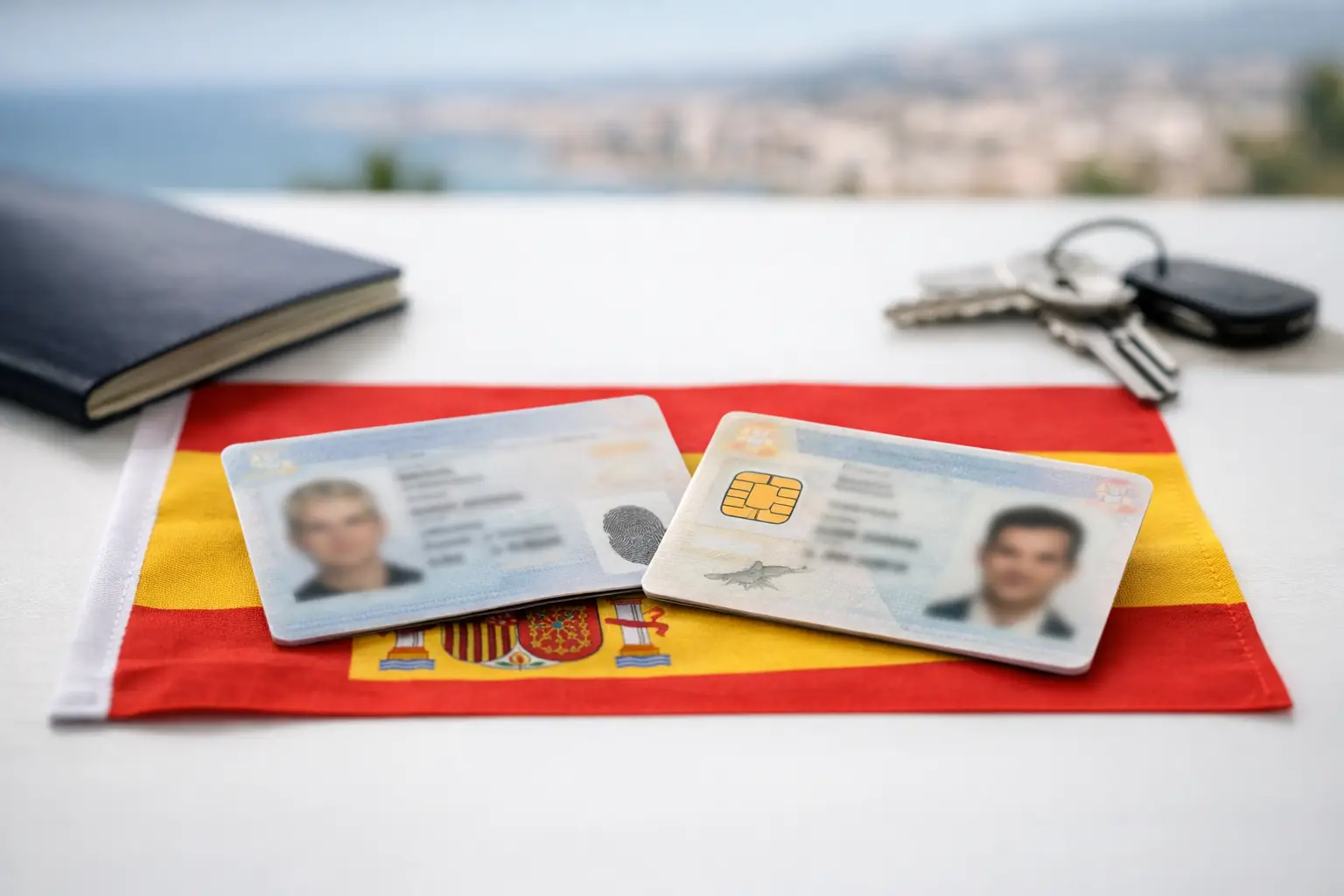
You can have an NIE in Spain and still have no right to live there. That is the point many applicants miss, and it is why confusion around NIE versus TIE in Spain causes real problems in bank appointments, police registrations, residence renewals, and even employment onboarding.
The two terms are related, but they are not interchangeable. In Spanish immigration practice, mixing them up can lead to filing the wrong procedure, booking the wrong appointment, or assuming your legal status is stronger than it actually is. If you are moving to Spain, regularizing your status, or helping an employee or family member relocate, the difference matters from day one.
NIE versus TIE in Spain: the core difference
An NIE is a foreigner identification number. TIE is the foreigner identity card that proves a non-EU national’s residence status in Spain. One is a number. The other is a physical card tied to an immigration authorization.
That distinction sounds simple, but the legal consequences are very different. The NIE can be assigned for many reasons that do not create residence rights. A person may receive an NIE to buy property, pay taxes, sign before a notary, or complete an administrative act in Spain. None of that means the person is a resident.
The TIE, by contrast, is generally the document that evidences an approved stay or residence authorization for non-EU nationals in Spain. If you have been granted a student stay, a digital nomad visa, non-lucrative residence, family reunification, or a work permit, the TIE is often the card that formalizes and proves that status once you are in Spain.
What an NIE actually does
The NIE, short for Numero de Identificacion de Extranjero, is your unique foreigner number in the Spanish system. It appears on immigration documents and is used across many administrative, tax, and legal processes.
Think of it as an identifier, not a status document. It allows Spanish authorities to register your presence in official records and connect you to a file, application, tax obligation, or transaction. You may need an NIE long before you become a resident, and in some cases you may only ever need the number without acquiring residence.
For that reason, saying “I already have my NIE” does not answer the legal question that matters most: what immigration status do you actually hold in Spain?
What a TIE proves
The TIE, short for Tarjeta de Identidad de Extranjero, is the plastic biometric card issued to certain foreign nationals in Spain. It includes your identity data, photograph, NIE number, and the type and validity of your immigration authorization.
This is the document many people really mean when they say they “have residency.” For non-EU nationals, the TIE is typically the practical proof of lawful stay or residence in Spain after the underlying authorization has been granted. It is used for day-to-day identification before the authorities and often requested by employers, schools, local administrations, and other institutions.
Not every foreign national in Spain will follow the same document path. EU citizens and their qualifying relatives may fall under different documentation systems, and the exact route depends on nationality, family relationship, and legal basis for residence. That is why document labels should always be checked against the person’s actual immigration category.
Who needs an NIE and who needs a TIE
Almost anyone interacting with Spanish administration as a foreign national may need an NIE. Property buyers, tax non-residents, inheritors, company directors, and visa applicants may all be assigned one. The triggering event is often administrative necessity, not residence.
A TIE is different. It is generally required when a non-EU national has authorization to remain in Spain for more than six months under a stay or residence regime that must be documented with a foreigner card. Students, employees, family members under certain routes, and residence permit holders commonly need to complete the TIE stage after approval.
This is where errors happen. Someone receives visa approval or a favorable residence resolution and assumes the process is finished. Legally, however, there is often a second step: fingerprinting and issuance of the TIE. Until that card is properly issued, the person may have approval on paper but still face practical obstacles proving status.
Why the confusion causes legal and practical issues
In daily life, people use NIE as shorthand for every foreigner document in Spain. Banks ask for it. landlords ask for it. employers ask for it. Even some applicants use the word when they really mean a residence card. That informal language hides an important legal distinction.
If you book an appointment asking only for an NIE when what you need is a TIE issuance appointment, you may lose valuable time. If your employer asks for proof of work authorization and you present a number without documentary evidence of residence rights, the issue is not semantics. It is compliance.
The same applies to renewals and follow-up procedures. The NIE number usually remains the same. The TIE card expires according to your authorization period and may need renewal, replacement, or updating. Confusing the permanent identifier with the time-limited residence card can lead to missed deadlines and unnecessary risk.
NIE versus TIE in Spain for visa holders and residents
For many non-EU nationals, the timeline works like this: first, an immigration application or visa is approved; second, the person enters or remains in Spain under that authorization; third, the person completes the police process for fingerprints and card issuance if the applicable route requires a TIE.
That means the NIE may already exist before the card is produced. In fact, your NIE number will appear on the TIE itself. The card does not replace the number. It incorporates it into a physical proof of status.
This is especially relevant for people on digital nomad visas, non-lucrative residence, student authorizations, work permits, and family-based residence routes. The underlying right comes from the approved immigration decision. The TIE is the document that usually evidences that right in a practical and recognizable form inside Spain.
When the answer depends on your category
Spanish immigration is document-heavy, but it is not one-size-fits-all. Whether you need only an NIE, or an NIE plus a TIE, depends on why you are in Spain and under which legal framework your case falls.
A non-resident buying real estate may only need the number. A student staying more than six months will usually need the card. A family member of an EU citizen may face a separate registration and documentation route. A person already in Spain changing status through arraigo or another regularization path may have a different procedural sequence than someone arriving with a consular visa.
This is why technical review matters. The right document is not based on what people casually call it. It is based on the exact immigration procedure, the validity period granted, and the authority that issued the decision.
Common misunderstandings to avoid
One common mistake is believing the NIE itself grants permission to work. It does not. Work rights come from the immigration authorization attached to your case, not from the existence of a foreigner number.
Another is assuming a valid passport and an NIE are enough to prove lawful residence. In many situations, especially for non-EU nationals already residing in Spain, the relevant proof is the TIE or the official resolution behind it.
A third misunderstanding is treating the TIE as if it creates status on its own. The card is evidence of status, not the legal source of the right. If there is an underlying error in the authorization, the existence of a card does not cure it. That is why immigration files should be reviewed as a whole, not only by looking at the plastic document.
Why professional guidance can save time
At first glance, NIE versus TIE in Spain looks like a vocabulary issue. In practice, it affects appointment strategy, document collection, proof of lawful presence, and the next steps in your immigration file. For families, employees, founders, and international professionals, those details have consequences.
A careful legal review helps confirm what you actually hold, what you still need to obtain, and whether your documentation matches your approved status. That is particularly useful in cases involving residence renewals, status modifications, family applications, employer-sponsored permits, or situations where prior paperwork was filed under the wrong assumption.
If your documents do not line up neatly, that usually means the case needs clarification, not guesswork. The most useful next step is often to verify the immigration category first and let the paperwork follow from that. When you understand whether you need a number, a card, or both, the system starts to make much more sense.

Francisco Campos Notario, Lawyer ICAS 15702 and specialist in Immigration Law, offers updated content in Lexmovea. Find valuable information about immigration, residency and nationality procedures. For personalized consultations, contact us or visit our offices in Madrid and Seville.